

Squat Muscles Worked: Glutes vs Quads
Why Some Squats Feel More Like Glutes and Others Feel More Like Quads
A squat is never just a “glute exercise” or just a “quad exercise.” It is always both to some degree.
What changes is which joint moment becomes more demanding. If the squat increases the demand at the knee, the quadriceps take on a larger share. If it increases the demand at the hip, the gluteus maximus becomes more important. A recent biomechanical review of the squat shows that trunk angle, tibia angle, stance, and depth all interact to change that balance.
What You’ll Learn in This Article
- Which muscles are the main drivers in a squat
- Why the squat is usually best understood as a glute + quad exercise
- The biggest levers that shift the bias between glutes and quads
- How depth changes the stimulus
- What matters less than people think
- Why squat machines often make glute or quad emphasis easier to repeat
Squats Train Both Glutes and Quads
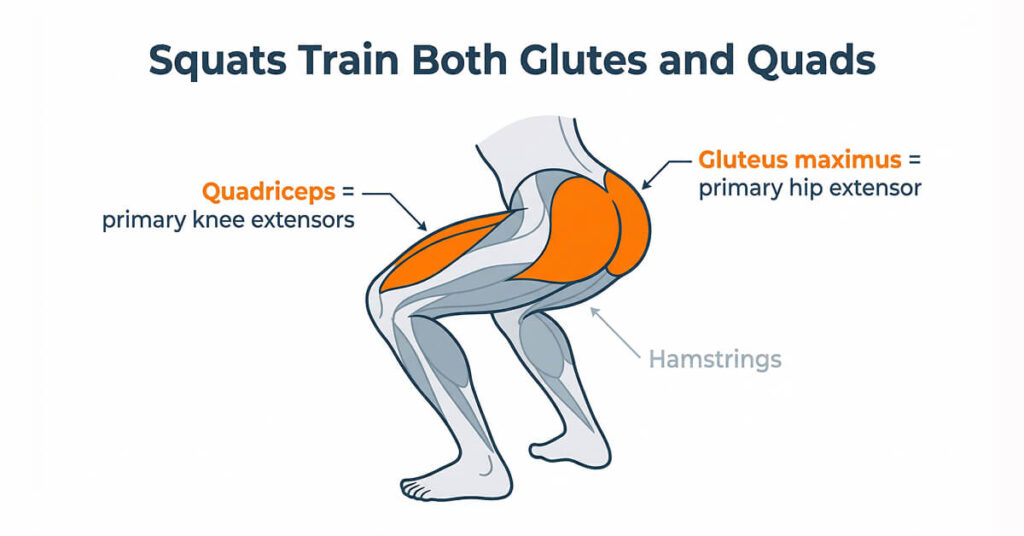
If you want to understand squat muscle bias, start with the two main jobs of the movement: knee extension and hip extension.
The quadriceps are the primary knee extensors, while the gluteus maximus is the main hip extensor. In a squat, both usually work hard because both the knee and hip have to extend to stand back up.
A 12-week training study comparing different squat depths found that full squat training was more effective for developing lower-limb muscles except the rectus femoris and hamstrings, which supports the practical idea that squats are primarily a glute-and-quad builder rather than a hamstring-dominant lift.
Quadriceps drive the knee side of the squat
The more a squat increases the knee flexion moment, the more demanding it becomes for the quadriceps. More upright squat patterns and greater forward tibia inclination both push the squat in that direction.
The gluteus maximus drives the hip side of the squat
The more a squat increases the hip flexion moment, the more important the gluteus maximus becomes. A more forward trunk inclination increases that hip flexion moment, which is why some squat styles feel much more “hip-driven” than others.
Why hamstrings are usually not the star of the squat
Even though the hamstrings help extend the hip, squat training does not seem to stimulate them the same way it stimulates the glutes and quads. In the depth study above, hamstring muscle volume was not one of the muscles that improved more with full squats, which is one reason the squat is usually programmed first as a quad-and-glute lift.
The Glute-vs-Quad Balance Is Mostly a Geometry Problem
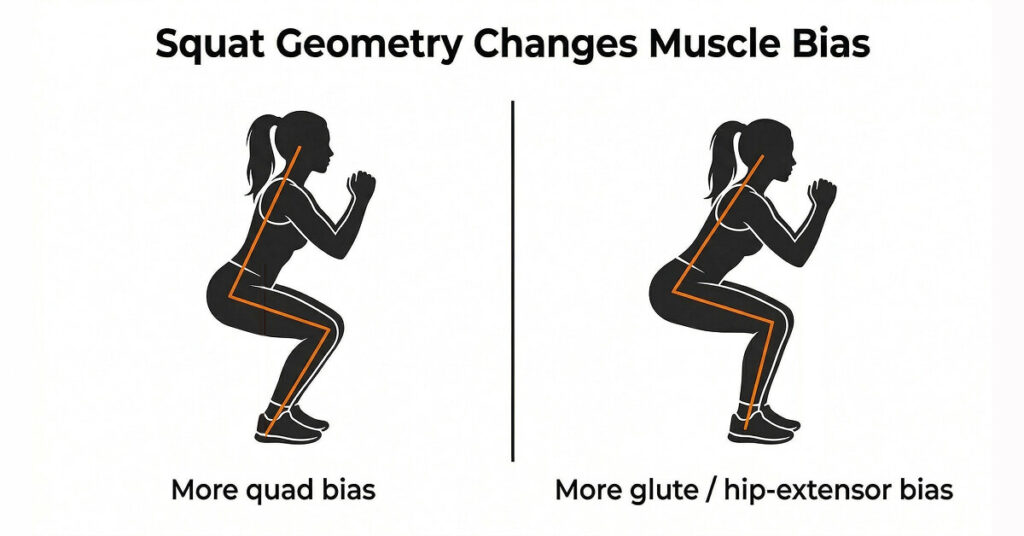
The fastest way to understand squat bias is to stop asking “What muscle does the squat work?” and start asking “Where is the bigger moment demand, hip or knee?”
A 2024 biomechanical review of the squat exercise explains this well: a more upright trunk increases the knee flexion moment and decreases the hip flexion moment, while a more forward trunk does the opposite. The same review also shows that moving the tibia forward increases the knee flexion moment, while keeping the tibia more upright decreases it. This is the best place to use the page’s single outbound link.
More upright torso + more forward knees usually means more quad bias
If you squat with a relatively upright torso and allow the knees to travel forward, the knee extensors usually take on a larger share of the work. That is why many front-squat or heel-elevated squat patterns feel more quad-dominant.
More forward torso + less forward tibia usually means more glute and hip-extensor bias
If the torso inclines forward more while the tibia stays relatively more vertical, the hip flexion moment rises relative to the knee flexion moment. That generally shifts the squat toward the glutes and other hip extensors.
The relationship matters more than any one cue
A cue like “knees forward” or “hips back” on its own is incomplete. The same review argues that the relationship between trunk and tibia inclination gives a better picture of squat bias than looking at either one by itself.
Depth Changes the Stimulus, but Not in a Simple Binary Way
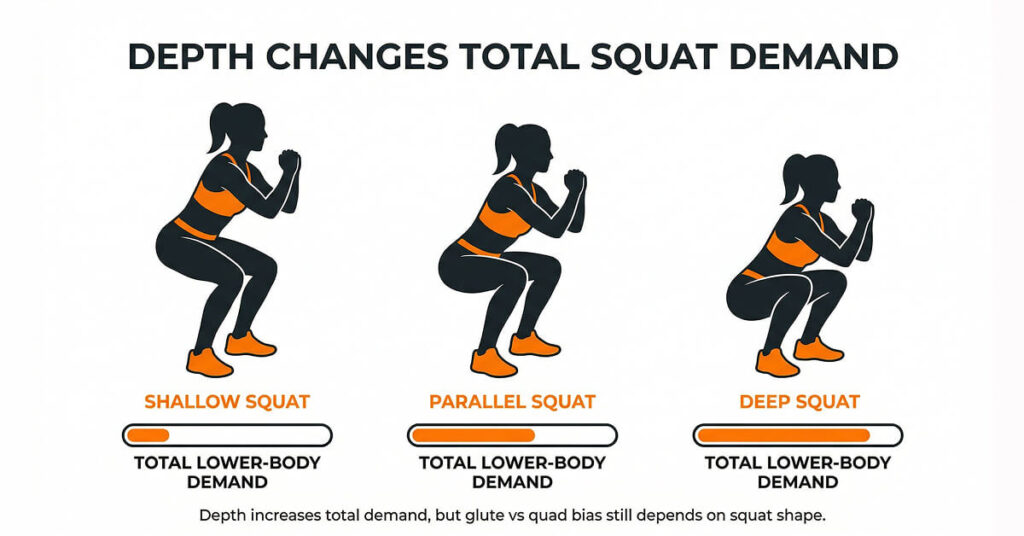
Depth does not magically “turn on glutes” or “turn off quads.” It changes how much total work the squat asks from both joints.
As squat depth increases, both knee and hip flexion moments generally increase, although the exact balance depends on how the trunk and tibia move as depth increases. In other words, deeper squats usually increase the total lower-body demand, but whether they feel relatively more glute- or quad-heavy depends on the shape of the squat.
Why deeper squats often become more glute-relevant
Deeper squats usually involve more hip flexion, which increases the need for hip extension on the way up. In the 12-week depth study, full squats were more effective than half squats for developing lower-limb muscles other than the rectus femoris and hamstrings, which supports using controlled, deeper squats when glute development is part of the goal.
Why do deeper squats not stop being quad exercises
The knee flexion moment also tends to rise with depth, especially when tibia inclination increases along with the depth. So a deep squat can still be very quad-demanding, particularly if the torso stays relatively upright or the heels are elevated.
What Changes the Bias Less Than People Think
Many lifters obsess over toe angle and tiny stance tweaks, even though those are rarely the biggest drivers of glute-vs-quad emphasis.
The squat review reports that rotating the foot outward has little effect on quadriceps activity, and that stance width does not appear to meaningfully change quadriceps activity either.
Wider stances have, however, been reported to increase gluteus maximus activity compared with narrower or medium stances, while quadriceps activity seems much less affected by stance width alone. That is why stance can matter, but usually not as much as trunk angle, tibia angle, and depth.
Machines Make Glute-vs-Quad Bias Easier to Standardize
Machines do not change the basic rule of the squat. They just make it easier to repeat the same rule every set.
Booty Builder’s squat/press category includes the Belt Squat, V Squat, Selectorized Pendulum Hip Press, Multi Leg Press/Hack Squat, and Multi-Angle Glute Press.
The Booty Builder machines are guided lower-body machines built for heavy loading potential and reduced joint stress compared with many free-weight setups, and specifically frames its squat solutions as a way to reduce spinal compression while keeping a glute-biased lower-body profile available. The practical coaching advantage is simpler: machines make torso position, tibia angle, foot pressure, and depth easier to repeat.
Belt Squat
Booty Builder’s Belt Squat is described as allowing a deep range of motion without spinal strain, with adjustable rack heights and a hip-loaded setup. In practice, that usually makes it easier to squat deep and train the glutes and quads hard without shoulder mobility or upper-back fatigue becoming the bottleneck first.
V Squat, Pendulum Hip Press, Hack Squat, and Multi-Angle Glute Press
Across guided squat/press machines, the biggest benefit is consistency. Booty Builder’s how-to page describes the Selectorized Pendulum Hip Press as using a guided pendulum arm to maximize glute and hip extension while minimizing spinal compression. More broadly, guided squat machines make it easier to keep a chosen squat shape, more upright and knee-dominant, or more hip-driven and glute-leaning, consistent across hard sets.
Key Takeaways
- Squats are primarily a glute-and-quad exercise, with the exact balance changing based on squat geometry.
- A more upright trunk and more forward tibia usually shift the squat toward the quads.
- A more forward trunk and relatively more vertical tibia usually shift the squat toward the glutes and other hip extensors.
- Deeper squats usually increase total lower-body demand, and controlled full-depth squatting can be especially useful when glute development matters.
- Machines are valuable because they make your chosen squat bias easier to repeat, not because they change the rules of squat biomechanics.