

Hip Thrust Programming
Sets, Reps, Tempo, and Progression for Glute Growth and Strength
Most hip thrust “programming problems” aren’t about motivation, they’re about not having a repeatable plan for weekly sets, effort, and progression.
Hip thrusts are one of the easiest glute builders to progress because the movement is stable and scalable, especially on a purpose-built hip thrust machine where setup, comfort, and alignment are easier to repeat. The goal of this page is to give you simple programming rules that work in real gyms: how much to do, how hard to train, how long to rest, what tempo to use, and how to progress week to week.
What You’ll Learn in This Article
- How many weekly hip thrust sets to start with (and how to adjust)
- The best frequency for hip thrusting based on your weekly volume
- Rep ranges for strength vs hypertrophy (and why both can build glutes)
- How to use RIR (reps in reserve) so you train hard without burning out
- Rest and tempo rules that keep performance high and reps consistent
- Progression methods that work especially well for hip thrusts
- Example sessions using Booty Builder machines (and optional barbell work)
The Training Pyramid: What to Prioritize First
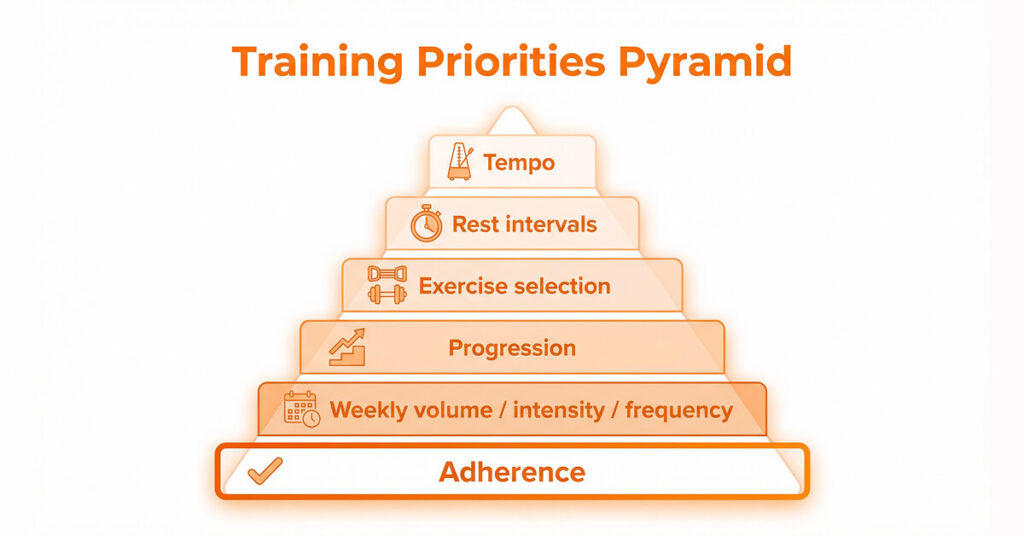
If you can’t progress consistently, it’s rarely because your tempo is wrong, it’s usually because the fundamentals below it aren’t locked in.
A practical way to prioritize programming is the “pyramid” idea: the bottom layers matter most, and the top layers only become important once the base is in place.
Key priorities (bottom → top):
- Adherence: a plan you can actually follow
- Training variables: weekly sets (volume), intensity (effort), frequency
- Progression: a method to increase challenge over time
- Exercise selection: covering the glutes from multiple angles
- Rest intervals: enough recovery to keep output high
- Tempo: a tool to standardize control and tension
Weekly Sets: How Much Hip Thrust Volume to Do
Your results won’t come from one killer session; they come from the weekly dose you can repeat and progress.
No study can give a single perfect number of sets for every person’s glutes. But research on hypertrophy broadly shows a dose–response trend where higher weekly set volumes often produce greater growth on average, up to a point where recovery becomes the limiter.
Practical rule (simple and usable):
Count only hard sets, sets that are challenging enough to be within roughly 0–5 reps from failure. Warm-ups don’t count. Dose–response relationship between weekly resistance training volume and increases in muscle mass (systematic review & meta-analysis)
Practical starting points (hip thrust sets per week):
- Beginner: 2–6 hard sets/week
- Intermediate: 4–10 hard sets/week
- Advanced (high glute priority + good recovery): 8–14 hard sets/week
How to adjust (weekly):
- If you’re progressing load/reps while keeping form clean → keep sets the same
- If you stall for 2–3 weeks and recovery is good → add +1–2 sets/week
- If performance drops session to session → reduce –2 to –4 sets/week before changing anything else
A Glute-Complete Week: The “Rule of Thirds” Template (Practical, Not Dogma)
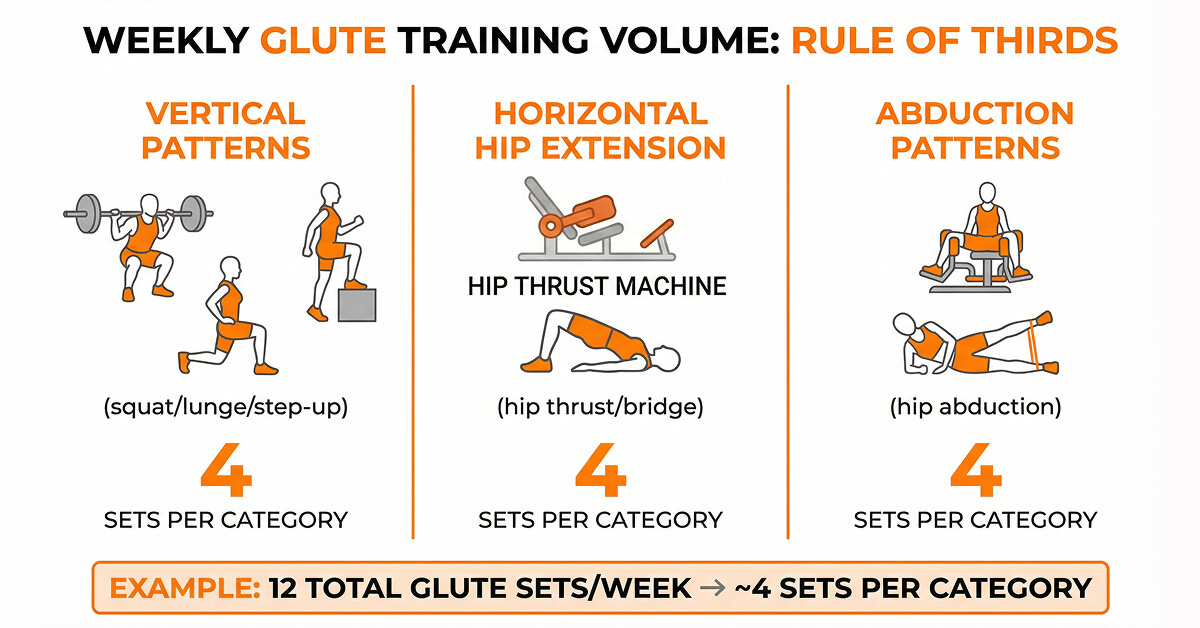
Hip thrusts build glutes best when they’re part of a week that also includes longer-ROM glute work and abduction/stability work.
A popular, practical way to structure glute training is to spread weekly glute sets across three categories:
- 1/3 Vertical lower-body patterns (squats/lunges/step-ups)
- 1/3 Horizontal hip extension (hip thrusts / bridges)
- 1/3 Abduction patterns (hip abduction variations)
How this helps your hip thrust programming:
If you aim for 12 total glute sets/week, a “third” gives you ~4 hip thrust sets/week as a clean default.
Frequency: How Often to Hip Thrust Each Week
Frequency is mostly a tool to keep set quality high, not a magic switch by itself.
When weekly volume is higher, spreading sets across more sessions usually keeps reps cleaner and performance higher. When volume is low, fewer sessions can work fine.
Practical frequency rules for hip thrusts:
- 2–6 sets/week → 1–2 sessions/week
- 7–10 sets/week → 2 sessions/week
- 11–14 sets/week → 2–3 sessions/week (split to keep output high)
Machine note (important):
A hip thrust machine makes higher frequency easier because setup is fast and repeatable, so you spend more time doing quality sets and less time rebuilding the lift each session.
Reps and Loading: Strength vs Hypertrophy (Both Can Build Glutes)
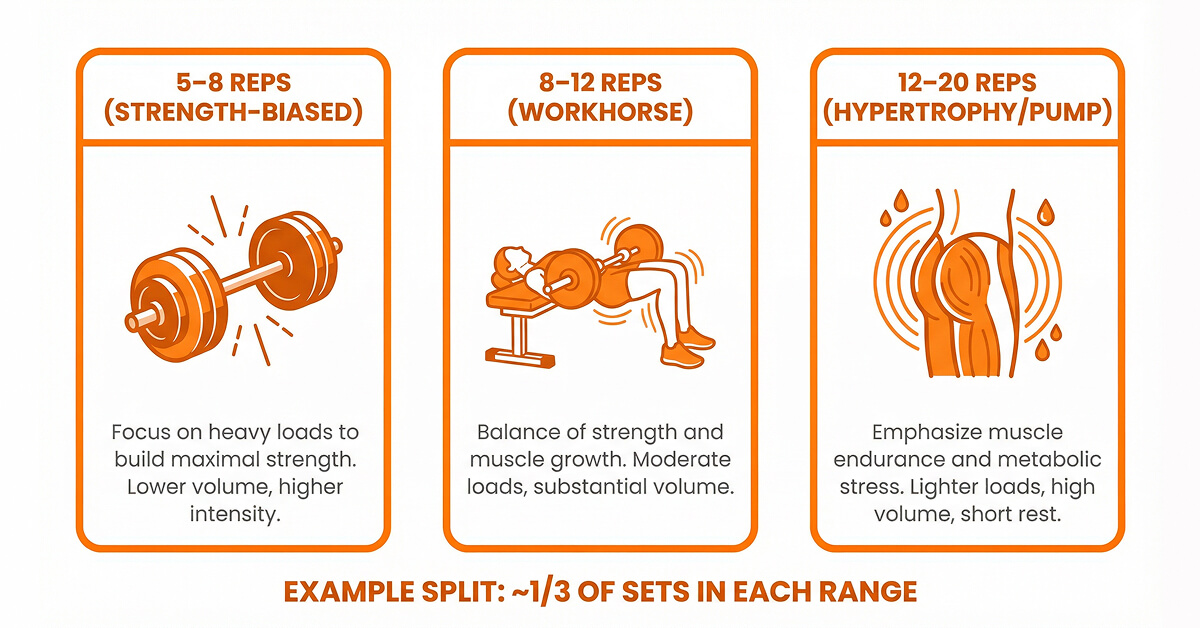
Rep range isn’t a “growth switch.” It’s a way to bias outcomes and manage fatigue while still training hard.
Hypertrophy can occur across a wide range of reps as long as sets are taken close enough to failure, while lower reps with heavier loads are generally more efficient for building maximal strength.
Use these rep ranges for hip thrusts:
- Strength bias: 3–6 reps (more rest, higher intent)
- Mixed strength + size: 6–10 reps (the “workhorse” range)
- Hypertrophy/pump bias: 10–20 reps (especially practical on machines)
A simple “coverage” approach (works well for glute blocks):
- ~1/3 of hip thrust sets in 5–8 reps
- ~1/3 in 8–12 reps
- ~1/3 in 12–20 reps
Intensity: Use RIR to Train Hard Without Burning Out
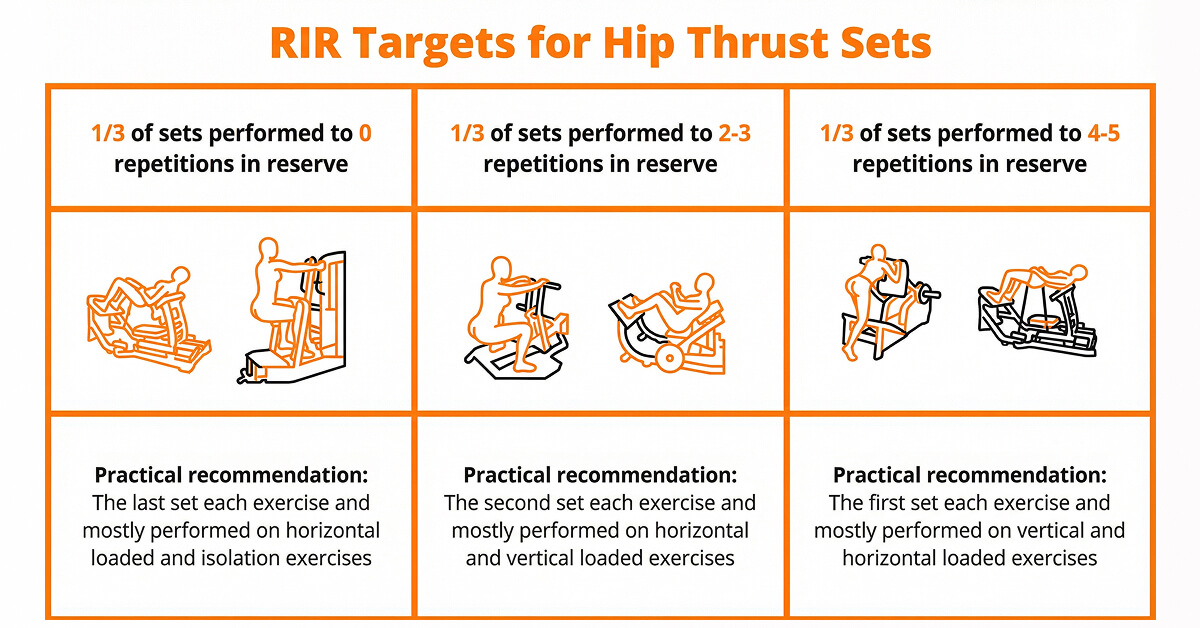
The goal isn’t “all failure, all the time.” The goal is enough hard sets that you can recover from and repeat weekly.
RIR (reps in reserve) is the cleanest way to program intensity without guessing. It also solves the big machine-vs-barbell confusion: you can’t compare load numbers across different equipment reliably, but you can compare effort (RIR).
Practical RIR targets for hip thrusts:
- Technique + volume sets: 3–5 RIR
- Productive hypertrophy sets: 1–3 RIR
- Occasionally (especially on machines): 0–1 RIR on the last set, if form stays locked in
Why machines help here:
Machines often make it easier to reach high effort without losing alignment, so your limiting factor is more likely to be the glutes, not setup instability.
Rest Intervals: Don’t Let Breath or Setup Limit Glute Output
If you rest too little, your next set becomes a cardio test, not a glute set.
Rest intervals should match your goal and keep performance high:
- Strength-focused hip thrusts: 2–4 minutes
- Hypertrophy-focused hip thrusts: 1–3 minutes
- Isolation work after hip thrusts: 60–120 seconds is usually enough
A simple readiness checklist before your next set:
- You’re not gasping for breath
- You believe you can hit the target reps with clean form
- Your glutes feel ready, not just your lungs
Tempo: The Hip Thrust Tempo That Works for Most People
Tempo is not the first driver of growth, but it is a powerful tool for keeping reps honest and repeatable.
For hip thrusts, you want enough control to eliminate bouncing and keep tension on the hips, without turning the set into slow-motion.
A simple, repeatable hip thrust tempo:
- Lower: 2–3 seconds
- Bottom: 0–1 second (no bounce)
- Up: controlled and strong
- Top: 1-second squeeze (stacked ribs/pelvis, full hip extension)
When to slow tempo more:
- When you can’t feel position at the bottom
- When you lose control near lockout
- When you’re using lighter loads and want more tension per rep
Progression Models That Work Especially Well for Hip Thrusts
Progression is what turns “working out” into a long-term glute-building plan.
Pick one model and run it long enough to prove it works before changing variables.
Double progression (best default for hypertrophy)
- Choose a rep range, e.g., 8–12
- Keep load the same until you hit the top end (with clean form)
- Then increase load slightly and repeat
Example:
3 × 8–12
When you can do 12, 12, 12 → add load next session
Linear progression (simple and effective for strength phases)
- Keep reps fixed (e.g., 4×5)
- Add a small amount of load when you hit all reps with good form
- If you stall, shift to a small rep range wave (see below)
Linear periodization (when weekly jumps stop working)
Over 4–6 weeks, gradually increase load while reps decrease:
- Week 1: 3×10
- Week 2: 3×9
- Week 3: 3×8
- Week 4: 3×7
- Week 5: 3×6
(Then reset slightly heavier than Week 1 and repeat.)
Example Programs
These are example sessions you can plug into a full plan. They’re written to be realistic in gyms and to take advantage of the repeatability and heavy-load potential of Booty Builder machines.
You can place hip thrust first or squat first, depending on the day’s priority. For strength, start with the lift you care most about progressing.
Strength Program (Booty Builder Equipment)
Goal: maximal hip-extension strength + clean heavy reps
Rest: 2–4 minutes on main lifts
| Exercise | Sets/Reps | Technique Notes |
|---|---|---|
| Hip Thrust Booty Builder Hip Thrust Machine | 4 × 5 | Explosive drive, full hip extension, 1-second pause at top. |
| Squat Booty Builder V Squat (or Belt Squat) | 3 × 4 | Controlled depth, even pressure through the feet. |
| Reverse / Sliding Lunge Booty Builder Reverse Lunge Machine | 2 × 8 / side | Control the eccentric, drive through the front foot. |
| Single-leg RDL / Hinge Selectorized Deadlift (hinge setup) | 3 × 8 / side | Hip hinge, neutral torso, controlled stretch. |
| Hip Adduction Booty Builder Standing Adductor | 2 × 8–12 | Smooth reps, no swinging. |
Hypertrophy Program (Booty Builder Equipment)
Goal: high-quality volume + controlled tension
Rest: ~90–180 seconds (shorter on isolations)
| Exercise | Sets/Reps | Technique Notes |
|---|---|---|
| Hip Thrust Booty Builder Hip Thrust Machine | 3 × 10–15 | 2–3 second lower, 1-second squeeze at lockout. |
| Bulgarian Split Squat Booty Builder Selectorized Deadlift/Split Squat | 3 × 8–12 / side | Controlled ROM, stable pelvis. |
| Back Extension (Glute) Booty Builder Back Extension | 3 × 10–15 | Drive through hips, avoid lumbar overextension. |
| Hip Abduction Booty Builder Multi-Abductor | 2–3 × 12–20 | Controlled reps, short rest, constant tension. |
Strength Program (Combined Barbells + Machines)
Goal: raw strength + machine stability for heavy hip extension
Rest: 2–4 minutes on main lifts
| Exercise | Sets/Reps | Technique Notes |
|---|---|---|
| Barbell Squat Rack / Free Weight | 4 × 3 | Brace core, control eccentric, explosive drive up. |
| Hip Thrust Booty Builder Hip Thrust Machine | 3 × 6 | Strong lockout, 1-second pause. |
| Bulgarian Split Squat Dumbbells | 3 × 6 / side | Controlled ROM, stable pelvis. |
| Back Extension (glute) Booty Builder Back Extension | 3 × 6–10 | Drive through hips, avoid lumbar overextension. |
Hypertrophy Program (Combined Barbells + Machines)
Goal: glute-focused volume + full lower-body stimulus
Rest: ~90–180 seconds
| Exercise | Sets/Reps | Technique Notes |
|---|---|---|
| Hip Thrust Booty Builder Hip Thrust Machine | 3 × 8–12 | Full extension, squeeze glutes hard at the top. |
| Barbell Squat Rack / Free Weight | 3 × 8–10 | Keep chest up, knees track over toes, control descent. |
| Step-Up Booty Builder Step-Up | 3 × 10–12 / side | Drive through the top leg, control the lowering phase. |
| Single-leg RDL Selectorized Deadlift (hinge setup) | 2 × 10–12 / side | Maintain neutral spine, hinge purely at the hips. |
| Hip Abduction Booty Builder Multi-Abductor | 2 × 15–25 | Constant tension, smooth movement, minimal rest. |
Quick Adjustment Rules (Use These Before You Change Everything)
When progress stalls, don’t “randomize.” Change one variable at a time.
Use this order:
- Check adherence (are sessions consistent?)
- Check effort (are sets actually hard enough?)
- Adjust weekly sets (+1–2 or –2 to –4)
- Adjust frequency (spread sets out if quality drops)
- Adjust rep range (swap 8–12 → 12–20 for a block, or 6–10 → 4–6)
- Then consider swapping a variation
Key Takeaways
- Weekly hard sets and progression drive results more than any single “perfect” tempo.
- Hip thrust machines are fully capable of heavy training; compare by RIR and performance, not plate numbers across setups.
- Use frequency mainly to keep set quality high as volume rises.
- Hypertrophy can be built across low-to-high reps if sets are challenging.
- Control the eccentric and own lockout with a short pause for consistent, glute-focused reps.