

Glute Anatomy & Biomechanics
The Scientific Foundation of Effective Glute Training
To train the glutes effectively, it’s not enough to focus on exercises or load alone. You need to understand how the glute muscles are structured, how they produce force, and why certain movement patterns, such as the hip thrust, align so well with their anatomy.
This section explains the science behind glute training and serves as the foundation for the exercise guides, programming strategies, and equipment applications used throughout Booty Builder.
What You’ll Learn in This Section
- How the three glute muscles differ in structure and function
- How glutes produce force during hip extension
- Why load curves and resistance placement matter
- How tempo and stability affect muscle growth
- Why controlled environments improve glute engagement
Overview of the Gluteal Muscle Group
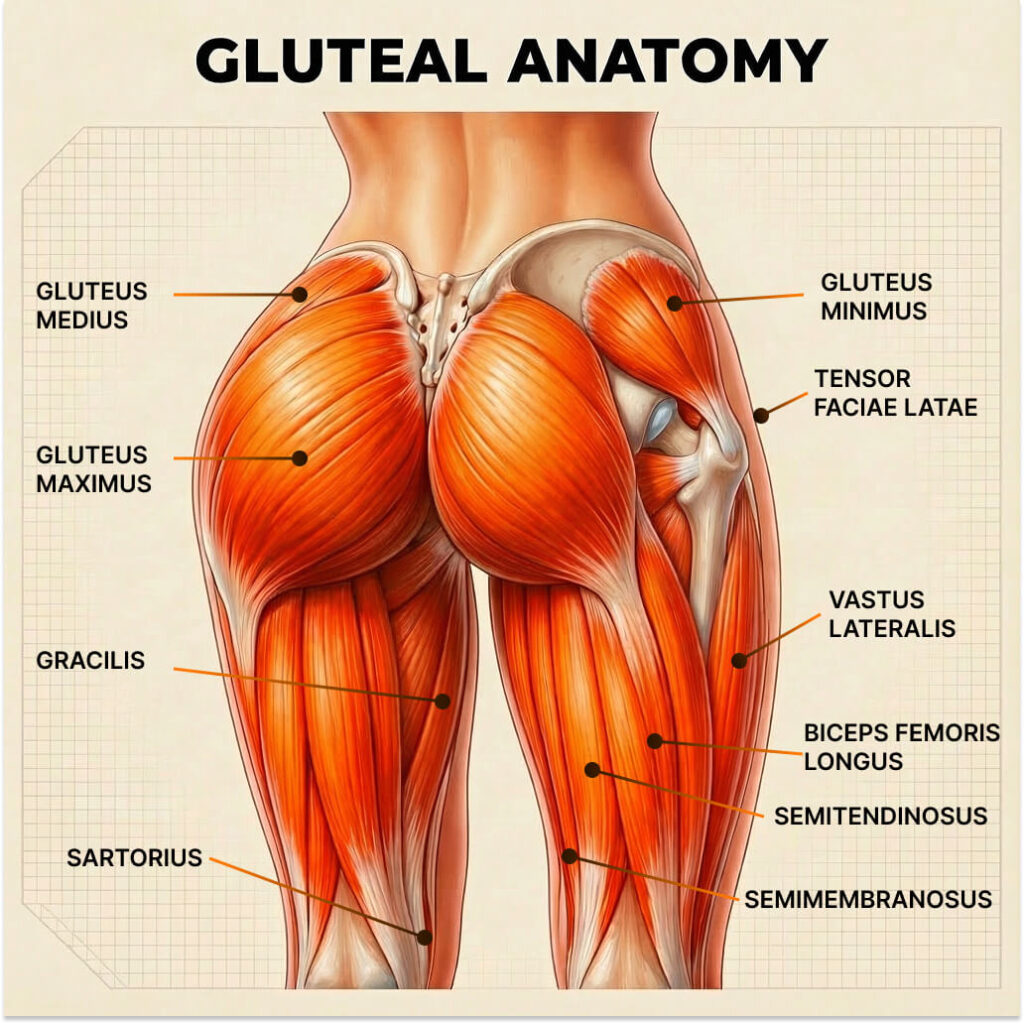
This illustrated anatomy diagram shows the gluteal muscle group, including the gluteus maximus, gluteus medius, and gluteus minimus, along with key surrounding muscles of the hip and thigh. The image is intended as a conceptual overview for understanding glute function in movement and training, rather than a precise medical illustration.
The Glutes Are a Functional Muscle System
The glutes are not a single muscle. They are a coordinated system responsible for hip extension, pelvic stability, and force transfer through the lower body.
Understanding this system helps explain:
- Why some exercises feel strongly glute-dominant
- Why others shift work to the hamstrings or lower back
- Why stability plays a critical role in effective loading
Why Anatomy Matters for Glute Training
Force Production vs Stability
Many training limitations occur before weight selection.
Without an anatomical framework:
- Stability demands override force production
- Growth potential is limited by compensations
When anatomy is respected:
- The gluteus maximus can express force near lockout
- Stabilizers assist instead of compete
- Tension is applied where it matters most
This principle underlies modern hip thrust–based glute training.
How Biomechanics Affects Training Outcomes
Joint Angles, Resistance Direction, and Control
Biomechanics determines how resistance interacts with the body.
Key factors include:
- Joint angles at the hip
- Moment arms through the range of motion
- Direction of applied resistance
- Consistency of load between repetitions
For glute training, biomechanics explains why:
- Vertical loading often underloads peak contraction
- Horizontal loading aligns better with hip extension strength
- Stability improves muscle recruitment
Load Curves, Tension, and Muscle Growth
Why Resistance Placement Changes Everything
A load curve describes how resistance changes throughout a movement.
For the glutes:
- Resistance is most effective near full hip extension
- Mismatched load curves reduce usable tension
- Consistent resistance improves repetition quality
Different hip thrust setups feel different largely because of how their load curves interact with glute anatomy.
Tempo, Control, and Hypertrophy
Mechanical Tension Over Time
Muscle growth is driven primarily by mechanical tension applied over time.
Tempo influences:
- Time under tension
- Momentum contribution
- Consistency across repetitions
Stable movement patterns make it easier to apply controlled tempo and maintain effective tension throughout the set.
From Anatomy to Application
Anatomy explains why glute training works.
The next step is applying these principles through movement, programming, and equipment.
Continue With
-
Glute Training Programming Guides (coming soon)
-
Hip Thrust Machine & Equipment Guides (coming soon)
Anatomy doesn’t change.
How training aligns with it determines results.