

Squat Form and Technique
Why Proper Squat Form Starts With a Repeatable Pattern
Most squat problems do not start at the knees. They start when a lifter tries to force one “ideal” squat style instead of building a pattern they can actually control.
A recent open-access biomechanical review of the squat shows that trunk position, tibia position, foot rotation, stance width, and depth all change joint loading and muscular demands. Proper squat form is therefore not about forcing every lifter into the same stance, shin angle, or torso angle. It is about finding a repeatable squat pattern that keeps you balanced, lets you move through useful range, and holds up when the load gets heavy.
What You’ll Learn in This Article
- How to set your stance and foot angle without guessing
- How to brace and stay balanced over the whole foot
- What a clean descent actually looks like
- How deep to squat for strength, muscle, and long-term progress
- How to stand up without folding or collapsing
- How to apply the same principles on barbell squats and Booty Builder squat machines
Setup: Build the Stance You Can Own
Good squats start before the first rep. If your setup changes every set, your technique usually changes with it.
Stance width and foot angle both affect squat mechanics, and the evidence does not support one universal “correct” stance for everyone. A practical starting point is a moderate stance with a slight toe-out, then adjusting from there until your knees and hips can flex cleanly without twisting or collapsing. Research on stance width and foot angle also suggests that extreme combinations are the positions that deserve the most caution, not ordinary moderate setups.
Find your stance and toe angle
- Start around shoulder width, then adjust slightly narrower or wider based on comfort and control
- Let the toes turn out as much as needed for your hips to move cleanly
- The right stance is the one that lets your knees track cleanly and your feet stay planted
Brace before you descend
- Inhale and create tension around your trunk before the rep starts
- Keep your ribcage and pelvis organized instead of lifting the chest excessively
- Think “locked in,” not stiff and exaggerated
Barbell-specific start position
- Set the bar height so you can unrack without tiptoeing or half-squatting it out
- Place the bar securely on the upper back position you can hold best
- Take only the steps needed to clear the rack and settle your stance
The Squat Is a Knee-and-Hip Bend Over the Whole Foot
A squat gets messy when lifters shift too far to the toes, rock back to the heels, or let the torso pitch wherever it wants.
During a squat, the system still has to stay balanced over the supporting surface. That is why “stay over the whole foot” is one of the most useful squat cues you can give.
Trunk angle also matters: a more upright squat generally shifts more demand toward the knee, while more forward trunk inclination shifts more demand toward the hip. Neither is automatically wrong. What matters is choosing the angle that matches the squat variation and that you can keep consistent rep to rep.
Keep the whole foot loaded
- Stay connected through heel, midfoot, and forefoot
- Do not let the arch collapse or the heel pop up to “find depth”
- Think “push through the floor,” not “sit into the toes”
Let the knees and hips bend together
- Start the descent by sitting down and between the feet, not by folding only at the waist
- Knees and hips should both contribute from the start
- Avoid turning the squat into either a pure knee shove or a pure hip hinge
Control the torso you chose
- More upright is not always better
- More leaned forward is not always worse
- The best torso angle is the one that keeps the bar or machine load balanced over your base and lets the rep stay consistent
The Descent: Let the Knees Travel Naturally
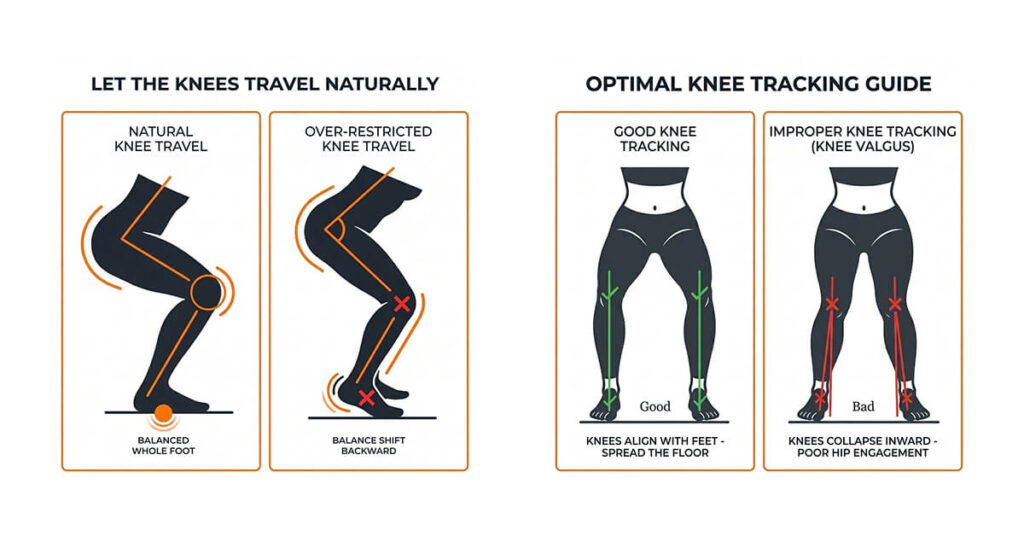
One of the most persistent squat mistakes is trying to force the shins vertical no matter what.
For healthy lifters, excessive restriction of forward knee travel is usually not a good default strategy. Modern reviews note that many lifters need some anterior knee travel to stay balanced and reach good depth, and that aggressively restricting the knees can shift more stress toward the hips and lumbar spine.
In other words: knees moving forward is not automatically bad squatting. The goal is not “knees never pass toes.” The goal is knees that travel naturally while staying aligned with the foot.
What good knee travel looks like
- Knees move forward as needed for your build and squat style
- Knees generally track in the same direction as the toes
- Knees do not cave inward as you descend
What to avoid
- Forcing the knees back so hard that the torso folds excessively
- Letting the knees collapse inward at the bottom
- Losing balance because you are chasing someone else’s squat style
Depth: Use the Deepest Range You Can Control
Depth is not just “how low can I go?” It is “how low can I go while keeping the rep honest?”
For most healthy lifters, deeper squatting is not inherently dangerous to the knees. A 2024 scoping review on deep squats and knee joint health concluded that deep squats appear to be safe for knee joint health when proper technique is maintained, and contemporary squat reviews also argue that full-depth squatting should not be restricted on a general basis in healthy individuals.
The practical takeaway is simple: Squat as deep as you can while keeping full-foot pressure, clean knee tracking, and a stable trunk/pelvis position.
What “good depth” actually means
- You can stay balanced over the foot
- Your knees and hips keep moving in a coordinated pattern
- Your trunk and pelvis do not visibly lose control just to steal more range
If ankle mobility is the limiter
Heel elevation can help. The squat literature shows that elevating the heels facilitates greater forward tibia inclination and can make it easier to squat with a more upright torso. That is why weightlifting shoes, heel wedges, or certain machine squat setups can be useful when ankle mobility is the main barrier to clean depth.
The Ascent: Drive Up Without Folding
Most ugly squats are not ruined at the bottom. They are ruined on the way up.
A strong ascent starts by pushing the floor away while keeping the rep shape you created on the way down. Your hips will rise, your chest will rise, and your knees will extend, but the goal is that they do it in a coordinated way instead of the hips shooting up first and turning the squat into a folded-over grind.
Best ascent cues
- Push the floor away
- Keep the whole foot loaded
- Let the chest and hips rise together enough that the rep keeps its shape
Finish the rep tall
- Stand up fully
- Do not overextend the lower back to “finish”
- End in a stacked, stable position, not a lean-back
Machine Squat Technique: Same Rules, Fewer Moving Parts
Machines do not remove squat technique. They simplify parts of it.
Booty Builder’s squat/press category includes the Belt Squat, V Squat, Selectorized Pendulum Hip Press, Multi Leg Press/Hack Squat, and Multi-Angle Glute Press. Across that lineup, the practical advantage is consistency: guided movement, supportive pads and footplates, and high load capacity can make it easier to repeat the same lower-body pattern from set to set. The Belt Squat is also positioned specifically as a way to load the lower body through the hips instead of the shoulders and upper back.
Belt Squat
- Treat it like a real squat, not a casual dip
- Brace first, then sit down between the feet
- Use the freedom of not carrying a bar to focus on depth and full-foot pressure
V Squat and Selectorized Pendulum Hip Press
- Keep the feet planted and let knees and hips bend together
- Use the pads and handles to stay braced, not to yank yourself through the rep
- Take advantage of the guided path to own the bottom position
Multi Leg Press/Hack Squat and Multi-Angle Glute Press
- Set foot placement so the knees can track cleanly with the toes
- Lower only as far as you can keep the pelvis and trunk controlled against the machine
- Push through the platform with even pressure instead of bouncing out of the bottom
Why machines are often easier to “do right”
- Less time spent solving balance and bar placement
- Easier start-position repeatability
- More mental energy available for effort, depth, and control
Quick Self-Checks for Better Squat Reps
You do not need a perfect squat. You need a squat that repeats.
Film from the side and from the front or 45 degrees. If the rep looks the same from the first rep to the last rep, you are usually in a much better place than someone chasing textbook positions they cannot keep under load.
Side-view checklist
- Full foot stays planted
- Descent and ascent look controlled, not rushed
- Torso angle stays appropriate for the variation instead of changing dramatically under load
- You finish tall without leaning back
Front-view checklist
- Knees track in the same general direction as toes
- No sudden knee cave or twisting
- Weight looks evenly distributed between right and left side