

Squat Common Mistakes and Knee Pain
Why Squats Can Irritate the Knees When the Pattern Stops Matching the Person
Most squat-related knee pain is not caused by squatting itself. It usually shows up when the squat style, depth, or loading no longer matches what the lifter can currently control.
That distinction matters. In healthy trained lifters, squatting deep is not automatically harmful to the knees. But in people with current anterior or patellofemoral knee pain, some squat positions and ranges can temporarily increase symptoms, especially if technique is inconsistent or the load is too aggressive for the knee’s current tolerance. The goal of this page is not to make squats look dangerous. It is to show which mistakes most often make them feel worse, and how to clean them up.
What You’ll Learn in This Article
- The most common squat mistakes that can make the knees feel worse
- Why “knees over toes” is usually the wrong thing to fear
- How depth, knee tracking, and torso angle change knee stress
- When to adjust range of motion instead of forcing reps
- Why machines can make knee-friendly squatting easier to repeat
- How to troubleshoot the next set in under a minute
Mistake 1: Forcing Vertical Shins and Treating “Knees Over Toes” as Wrong
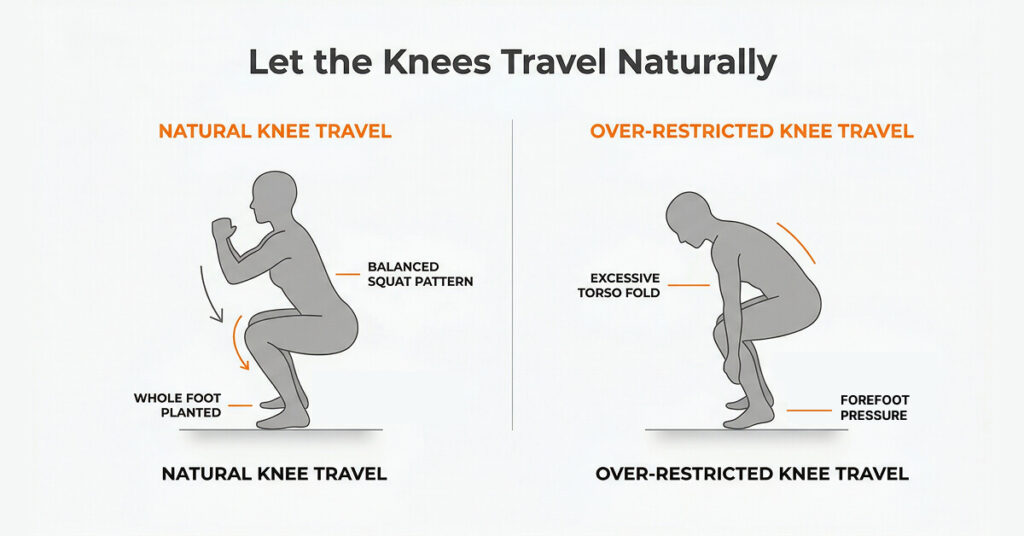
Why this often backfire
A very common squat mistake is trying to keep the shins vertical at all costs. In healthy, trained lifters, that is usually not a good default. A comprehensive review on anterior knee displacement in the squat concluded that allowing some forward knee travel is often favorable, or even necessary, for good squatting mechanics, and that deliberately restricting it can shift much more torque to the hips and lumbar spine.
What to do instead
Let the knees travel forward as much as your structure and squat style need, while keeping the whole foot planted and the knees tracking in line with the toes. If you already have front-of-knee pain, reducing forward knee travel can still be useful as a temporary symptom-management strategy. Still, it should be treated as a short-term modification, not a permanent rule for everyone.
Mistake 2: Letting the Knees Collapse Inward Rep After Rep
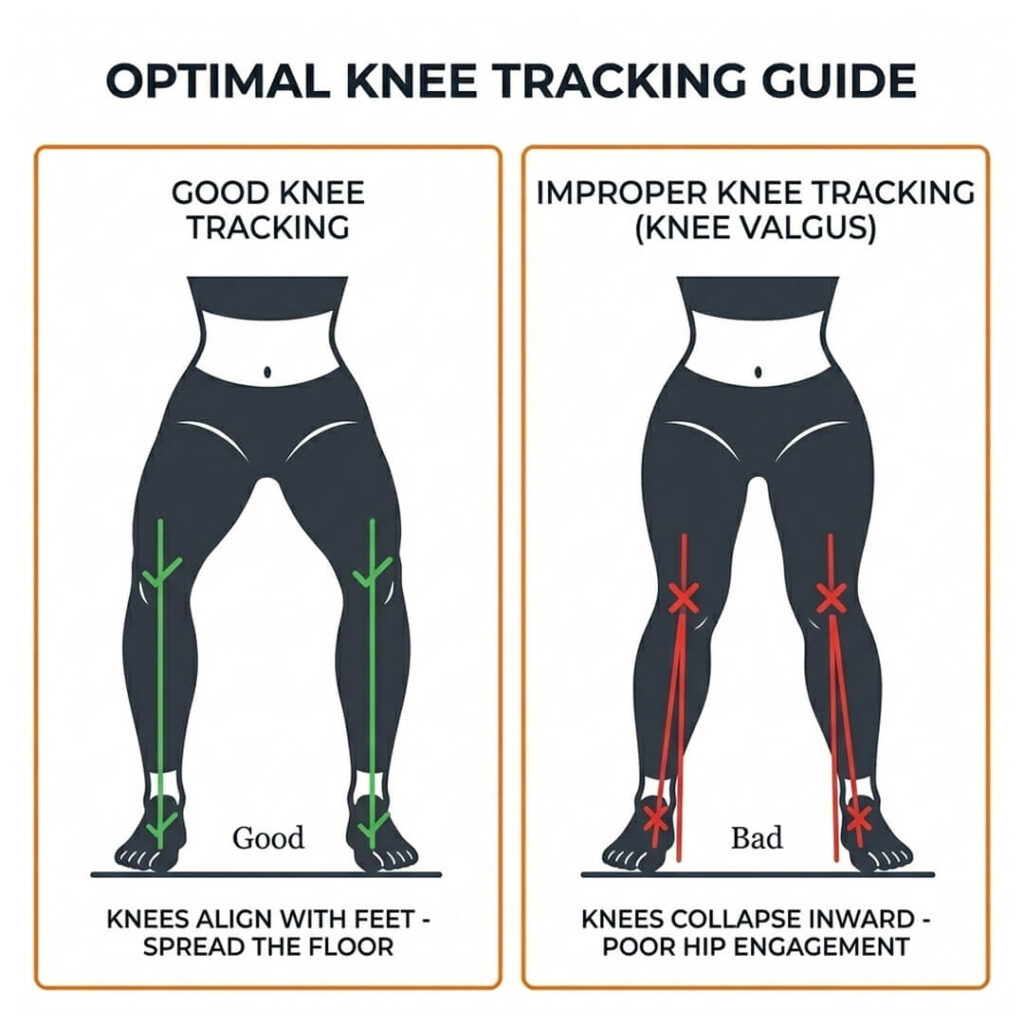
Why this can irritate the knee
Occasional small movement is normal, but repeated, uncontrolled knee cave usually means the femur is adducting and internally rotating more than you want. In patellofemoral pain literature, medial femur rotation and adduction are associated with increased patellar cartilage stress, and dynamic valgus is commonly discussed as a contributor to patellofemoral overload.
What to do instead
Think “foot rooted, knee tracks with toes,” not “shove the knees out as hard as possible.” If the collapse keeps showing up, reduce the load, slow the descent, and clean up the rep first. If it is a persistent pattern, it also makes sense to address the hip side of the problem, not just the knee, because hip-focused or combined hip-and-knee strengthening programs are commonly effective for reducing patellofemoral pain and improving function.
Mistake 3: Chasing Depth You Cannot Currently Control
Deep is not the problem. Uncontrolled deep is.
Deep squats are not automatically bad for the knees. A 2024 scoping review concluded that deep squats appear safe for knee joint health when proper technique is maintained. The problem is when a lifter goes deeper than they can currently control, loses foot pressure, lets the pelvis or trunk shift, or drops into a painful bottom position just to “hit depth.”
What to do instead
Use the deepest range you can control right now. If your knees are currently symptomatic, especially with anterior or patellofemoral pain, temporarily using a shallower or medium-depth squat is often the smarter move. The squat biomechanics review specifically notes that shallow-to-medium depth squats are generally the better prescription for patellofemoral pain when the goal is minimizing joint stress while symptoms calm down.
Mistake 4: Forcing an Extremely Upright Squat Even When the Knees Hate It
Why some knees do better with a slightly more hip-dominant pattern
A very upright squat with lots of forward knee travel can be a great option for quad development, but it is not automatically the best choice when the front of the knee is already irritated. Physical therapy guidance for anterior knee pain notes that, in deeper knee flexion ranges, increasing trunk and hip flexion can reduce patellofemoral stress in some squat-related tasks.
What to do instead
If your knees are flaring up, do not force the same upright, knee-dominant squat just because it looks “cleaner.” A slightly more hip-driven squat, a box squat, or a Belt Squat can often let you keep training the pattern while reducing irritation. This is not about turning every squat into a hinge. It is about choosing the squat shape your knees currently tolerate best.
Mistake 5: Letting Fatigue Turn Every Rep Into a Different Squat
Why this matters for the knees
A squat that starts controlled and then gradually becomes a different movement is much more likely to aggravate symptoms. The deeper-squat review’s key conclusion is not just that deep squats can be safe; it is that they are safe when technique is maintained. Once the rep shape changes, the value of the set drops and the stress pattern changes with it.
What to do instead
End the set when you lose the rep shape you intended to train. That usually means:
- heel pressure stays down
- knees still track cleanly
- depth is still controlled
- the torso is not suddenly pitching or twisting to escape the bottom
This is one reason machine squats can be so useful: they make it easier to keep the same squat shape from the first rep to the last.
Why Squat Machines Often Make Knee-Friendly Squatting Easier to Repeat
Machines do not make knee pain disappear. They make the squat easier to standardize.
In the Booty Builder squat/press lineup, the Belt Squat, V Squat, Selectorized Pendulum Hip Press, Multi Leg Press/Hack Squat, and Multi-Angle Glute Press all give you more control over foot placement, support, and repeatability than a barbell. That matters when the goal is to find a squat pattern your knees tolerate well and then repeat it consistently.
Belt Squat
The Belt Squat is often the easiest place to start when knee symptoms are mixed with upper-back fatigue, bar discomfort, or shoulder mobility issues. It lets you keep training a real squat pattern while loading through the hips instead of carrying a bar on the back.
V Squat and Selectorized Pendulum Hip Press
These are useful when you want a guided squat/press pattern that makes depth and knee tracking easier to repeat. The practical benefit is not that the machine “fixes” bad reps for you. It is that fewer moving parts usually means less setup drift and more consistent reps.
Multi Leg Press/Hack Squat and Multi-Angle Glute Press
These are useful when you need more control over setup and a more repeatable lower-body pattern while symptoms settle. The Multi Leg Press/Hack Squat, in particular, is built around adjustable pads and plate positions to improve alignment and stability, which is exactly the kind of control that helps when you are trying to keep the squat pattern consistent.
30-Second Troubleshooting Checklist
- Pain mainly at the front of the knee? Reduce depth temporarily and stop forcing an ultra-upright, knee-dominant squat.
- Knees collapsing in? Lower the load and clean up foot pressure before adding more weight.
- Trying to keep knees behind toes? Let them travel naturally and keep the whole foot loaded.
- Every set looks different? End the set earlier or switch to a machine variation you can repeat more consistently.
When to Stop and Get Assessed
Training discomfort and a medical knee problem are not the same thing.
Stop the session and get medical advice promptly if the knee is badly swollen, hot or red, locks, gives way, changes shape, or you cannot bear weight properly. Those are not “just squat form” issues.
Key Takeaways
- The most common squat mistake for knee pain is not “squatting too low.” It is using a squat style the knees cannot currently tolerate or control.
- For healthy lifters, forcing vertical shins is usually the wrong default. Natural knee travel is often necessary for a good squat.
- Uncontrolled knee cave, painful depth, and fatigue-driven rep changes are the patterns most worth fixing first.
- Machines are valuable because they make productive, repeatable squatting easier, not because they change the basic rules of the squat.