

Squat Benefits
Why Squats Stay Central in Lower-Body Training
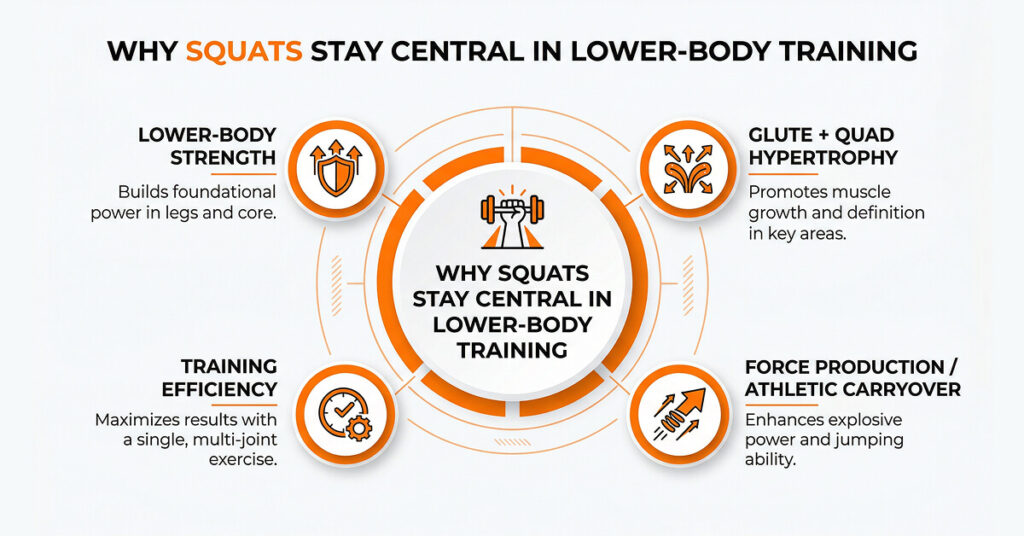
Squats are one of the few lower-body exercises that stay relevant across almost every goal: strength, hypertrophy, athletic development, and general lower-body training.
That is because a squat is not just a “leg exercise.” It is a coordinated lower-body pattern that trains knee extension, hip extension, and whole-body force transfer at the same time. A recent biomechanical review highlights that squat mechanics can be modified through trunk angle, tibia angle, stance, and depth, which is a big reason the exercise is so versatile: the same basic pattern can be adjusted to emphasize different outcomes without becoming a completely different lift.
What You’ll Learn in This Article
- Why squats are such a strong lower-body strength builder
- How squats contribute to glute and quad development
- Why depth is one of the squat’s biggest advantages when it is controlled
- How squats support athletic performance and force production
- Why machines can make squat training easier to repeat and progress
- How to get the benefits without turning squats into a fatigue-driven mess
Benefit 1: Squats Build Serious Lower-Body Strength
One of the most obvious benefits of squats is simple: they work.
Squat training is a legitimate way to improve lower-body maximal strength. In a 6-week study comparing a squat-based program with a deadlift-based program in resistance-trained men, the squat group improved squat 1RM more, while both groups also improved jump performance. That is a useful reminder that the squat is not only a bodybuilding exercise or a technique drill—it is a true strength lift with carryover to power-focused tasks.
Why this matters in real programming
- If your goal is stronger legs and hips, the squat can absolutely be a main lift
- If your goal is broader lower-body power, squat training can still contribute meaningfully
- The payoff comes from progressive, repeatable reps—not just “going heavy” for the sake of it
Benefit 2: Squats Build Glutes and Quads at the Same Time
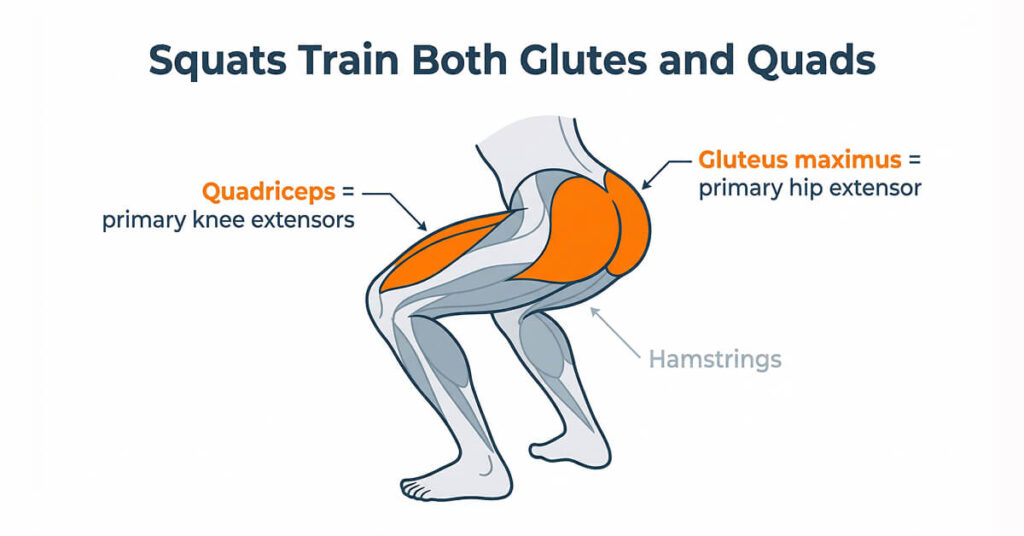
A major reason squats remain valuable is that they do not force you to choose between glutes and quads. They train both.
Squats are especially useful when you want broad lower-body development instead of trying to isolate one region at a time. In a 9-week training study comparing back squats and hip thrusts in novice trainees, both exercises produced similar gluteal hypertrophy, while squats produced greater quadriceps and adductor hypertrophy. That makes the squat a very efficient choice when you want strong glute stimulus and more complete thigh development.
Why this matters for glute-focused training
- Squats are not “just a quad lift”
- They can be a strong glute builder when depth and loading are appropriate
- They also tend to train more of the thigh than thrust-only programming
Benefit 3: Squats Reward Controlled Depth
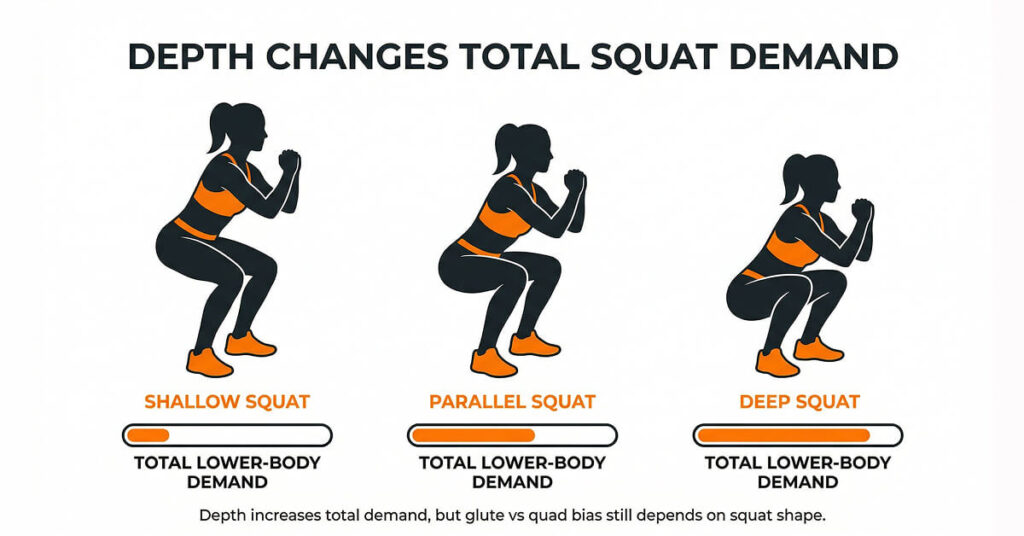
One of the biggest advantages of the squat is that it can train the lower body through a large range of motion.
That matters for hypertrophy and general lower-body development. A systematic review on range of motion in resistance training concluded that, for the lower body, full-ROM training generally produces similar or greater hypertrophy than partial-ROM training. In the squat-specific study included in that review, the deeper squat condition produced greater increases in gluteus maximus and adductor muscle volume than the shallower condition.
Why this is a real benefit
- More usable range means more ways to challenge the lower body
- Deeper controlled squatting tends to make the glutes more relevant, not less
- It also makes the squat more than a top-half “load test”
Important qualifier
Depth only helps if you can control it. The benefit is not “go lower at all costs.” The benefit is using the deepest range you can own while keeping full-foot pressure, clean knee tracking, and a stable trunk and pelvis. A 2024 scoping review on deep squats also concluded that deep squats appear safe for knee joint health when proper technique is maintained.
Benefit 4: Squats Improve Force Production That Transfers Beyond the Lift
Squats are valuable because they teach you to produce force through the floor with the hips and knees working together.
That is one reason squat strength is so often used as a foundation in sport preparation and lower-body programming. In the squat-vs-deadlift study, both groups improved jump performance over the 6-week training period, showing that heavy lower-body strength work built around the squat can contribute to explosive lower-body tasks when the overall program is structured well.
What this means practically
- Squats are useful when you want stronger legs, not just bigger legs
- They fit well in programs where performance matters alongside hypertrophy
- They teach coordinated hip-and-knee extension under load
Benefit 5: Squats Are One of the Most Efficient Compound Lower-Body Lifts
If training time is limited, squats give a lot back per set.
Because the squat involves both the knee and hip extensors together, it can create a meaningful training effect without needing a long menu of separate exercises.
That does not mean squats replace every other lower-body movement, but it does mean they are highly efficient when you want one movement that can meaningfully train the glutes, quads, and overall lower-body strength at the same time.
Squat training has also been shown to increase quadriceps cross-sectional area across all four quadriceps heads after 7 weeks of parallel squat training in healthy adults.
Benefit 6: Squat Machines Make Productive Squatting Easier to Repeat
By removing the systemic demands of balance and stabilization, squat machines create a highly controlled environment to maximize mechanical tension in the lower body.
Booty Builder’s squat / press lineup includes the Belt Squat, V Squat, Selectorized Pendulum Hip Press, Multi Leg Press/Hack Squat, and Multi-Angle Glute Press. The category is built around guided lower-body patterns, heavy loading potential, and lower-body training with less setup friction than many free-weight options. In practice, that matters because repeatability is one of the biggest drivers of progress.
Why machines are useful here
- They make stance, foot pressure, and depth easier to repeat
- They reduce the time spent solving bar placement, unracking, or balance
- They often let more of your effort go into the lower body itself, not the setup
Where the Booty Builder lineup fits
The Belt Squat is useful when you want to load the lower body hard without putting a bar on the back, while guided options like the V Squat, Pendulum Hip Press, Multi Leg Press/Hack Squat, and Multi-Angle Glute Press give you stable lower-body patterns that are easier to standardize across hard sets. That makes them especially practical in hypertrophy phases, higher-volume weeks, and commercial gym environments where repeatability matters.
How to Get the Benefits Without Turning Squats Into a Recovery Problem
Squats are productive, but they still have to be programmed and executed well-
The biggest mistake is assuming the squat is automatically beneficial no matter how it is performed. The benefits show up when the pattern stays stable, the depth is controlled, and the load matches the variation. If the rep shape collapses, the value of the set usually drops fast.
That is one reason machine squats can be so useful: they often make it easier to keep the rep the same from the first repetition to the last.
Practical rules
- Use the deepest range you can control
- Keep the whole foot loaded
- Choose the squat variation that lets you repeat the pattern cleanly
- Treat machine squats as a progression tool, not a downgrade from “real” training
Key Takeaways
- Squats are one of the best lower-body strength builders because they train hip and knee extension together under load.
- They can build glutes and quads at the same time, which makes them highly efficient for lower-body hypertrophy.
- Controlled depth is a major advantage of squat training, not something to avoid by default.
- Squats also support lower-body power and force production when programmed well.
- Machines are valuable because they make productive squat training easier to repeat, especially when the goal is consistent lower-body overload.