

Static Machine Split Squat vs Walking Lunge
Static vs Moving is the Real Difference
A machine-supported split squat and a walking lunge can look similar because both train one leg at a time. But mechanically, they solve different problems.
A static machine split squat keeps the stance fixed and the setup repeatable, which makes it easier to load the front leg hard and compare progress from set to set. A walking lunge adds movement: every rep includes a step, a landing, a transition, and a new stance. That makes it more dynamic, but also less controlled. For glute growth and progressive overload, the static machine split squat is usually the stronger primary exercise. For conditioning, coordination, and dynamic unilateral work, walking lunges still have value.
What You’ll Learn in This Article
- The real difference between a static machine split squat and a walking lunge
- Why machine-supported split squats are usually better for heavy, repeatable glute training
- Why walking lunges are still useful, but for a different purpose
- How balance, stride length, and setup variability change the stimulus
- Which option to choose for hypertrophy, strength, knee comfort, conditioning, or athletic carryover
- How to use both in the same program without overlapping their roles
What Is a Static Machine Split Squat?
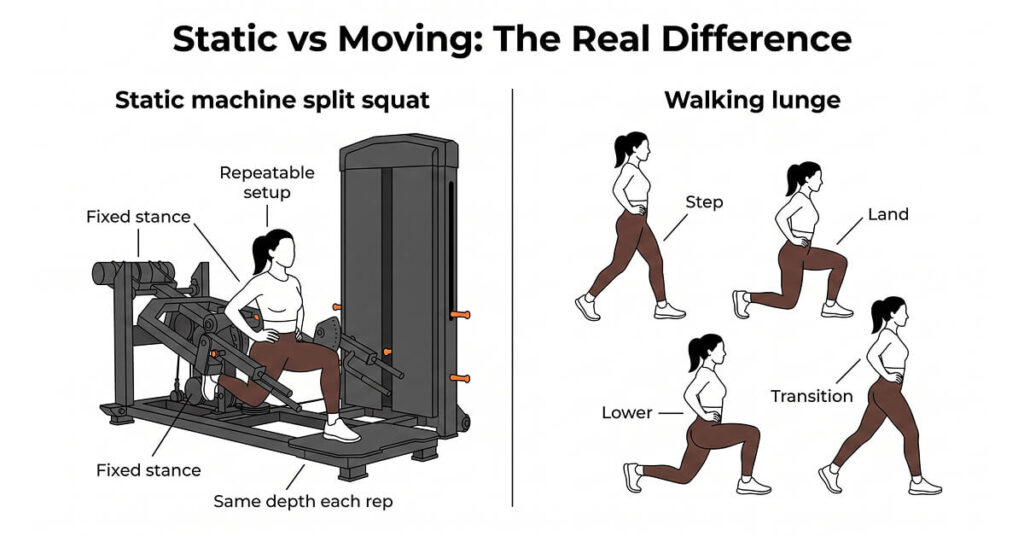
A static machine split squat keeps both feet in a fixed setup while the front leg performs most of the work.
In a machine-supported split squat, the rear foot is supported, the front foot stays planted, and the handles or frame provide stability. The movement is still hard, but the setup removes many of the distractions that often limit free-weight split squats: balance loss, rear-foot discomfort, inconsistent stance length, grip fatigue, and awkward loading.
The main training advantage
The biggest advantage is repeatability.
A static machine setup makes it easier to repeat:
- front-foot position
- rear-foot height
- stance length
- depth
- torso angle
- loading
- left-versus-right comparison
That matters because hypertrophy and strength depend on progression. If the setup changes every rep, it becomes harder to know whether the working leg is actually getting stronger.
Stability does not make it easy
Machine support does not make the split squat less serious. It usually makes the exercise more productive because more effort can go into the front leg instead of maintaining balance or fighting the setup.
For glute-focused training, that is a major benefit. The goal is not to make the exercise unstable. The goal is to make the target muscles work hard through a controlled range of motion.
What Is a Walking Lunge?
A walking lunge is a moving unilateral pattern where each rep includes a step forward, a landing, a lowering phase, and a transition into the next rep.
That movement makes walking lunges more dynamic than static split squats. Instead of repeating one fixed stance, you have to recreate your stride every rep. This adds coordination, rhythm, and balance demand, but it also makes the exercise harder to standardize.
The main training advantage
Walking lunges are useful when you want:
- dynamic unilateral coordination
- conditioning or work capacity
- continuous alternating-leg movement
- a more athletic-feeling lower-body drill
- variety after heavier strength work
The main limitation
Walking lunges are harder to progress precisely.
Stride length, foot placement, torso angle, fatigue, and floor space can all change during a set. That does not make walking lunges bad. It just means they are usually less ideal as the main heavy progressive-overload exercise for glute hypertrophy. This is the reason why we invented the Reverse Lunge Machine.
Muscle Stimulus: Fixed Front-Leg Loading vs Step-to-Step Variation
Both exercises train the glutes, quads, adductors, and stabilizers. The difference is how consistently those muscles are loaded.
A study comparing split squats and walking lunges notes that the two exercises are similar but differ in the eccentric phase, and that loading position can change kinematics and muscle activity during both movements. That is exactly why exercise choice matters: even small differences in setup and movement pattern can change what the set emphasizes.
Does the dumbbell-carrying position change the muscle activity in split squats and walking lunges?
Static machine split squat stimulus
A machine-supported split squat is usually better when the goal is a consistent hypertrophy stimulus because the same leg, same stance, same depth, and same resistance path can be repeated across the set.
That makes it easier to:
- take the front glute and quad close to failure
- keep the pelvis controlled
- compare right and left sides
- progress load or reps cleanly
- maintain the same range of motion under fatigue
Walking lunge stimulus
A walking lunge can still create a strong lower-body stimulus, especially when the stride is controlled and the load is challenging. But the stimulus is more variable because each rep includes a new step.
Walking lunges often become limited by:
- balance
- stride consistency
- grip or load position
- available space
- fatigue changing step length
- coordination between reps
For conditioning and athletic-style training, that variability can be useful. For targeted glute hypertrophy, it can become the limiter.
Why the Static Machine Split Squat Usually Wins for Glute Growth
For glute growth, the best exercise is usually the one you can load hard, control deeply, and repeat consistently.
That is where the machine-supported split squat has the edge. It removes enough instability to let the working leg become the main limiter.
More stable setup
A stable setup lets you use higher effort without the set falling apart because of balance. That is especially important near failure, where walking lunges often become shorter, faster, or less controlled.
Better progressive overload
Selectorized or guided machine loading makes it easier to progress in a measurable way. You can track:
- load
- reps
- range of motion
- side-to-side differences
- RIR
- total weekly volume
With walking lunges, progression is less clean because distance, stride length, and rep quality can drift.
Better control at the bottom
A machine-supported setup makes it easier to pause, control depth, and drive through the front leg without rushing into the next step.
That matters for glute training because the bottom position is where many lifters either gain or lose the stimulus. If they lose pelvic control or bounce out of the bottom, the exercise becomes less targeted.
Why Walking Lunges Still Have a Place
Walking lunges are not inferior. They are simply better for a different job.
A walking lunge has a dynamic quality that static split squats do not. Each rep requires stepping, decelerating, stabilizing, and moving into the next stride. That can be useful when the goal is not just isolated strength or hypertrophy, but also coordination and work capacity.
Best uses for walking lunges
Walking lunges work well as:
- a conditioning finisher
- a moderate-load accessory exercise
- a dynamic unilateral drill
- a way to add variety after heavy machine or barbell work
- a lower-body movement that challenges rhythm and coordination
When walking lunges are not the best choice
Walking lunges are usually not the best main choice when:
- glute hypertrophy is the main priority
- you want precise right-left loading comparisons
- balance limits the set before the muscles do
- floor space is limited
- you need consistent depth and stance every rep
- knee symptoms worsen when stride length or landing changes
Knee and Pelvis Control: Which One Is Easier to Manage?
The static machine split squat usually gives you more control over the knee and pelvis because fewer variables change during the set.
In a walking lunge, every step asks you to place the foot, absorb the landing, lower the body, stand up, and transition forward. That can be valuable, but it also means every rep is a chance for the knee path, pelvis position, and stride length to change.
Static machine advantage
A static machine split squat makes it easier to keep:
- front foot planted
- knee tracking consistent
- pelvis square
- torso angle repeatable
- depth consistent
- rear leg from taking over
Walking lunge advantage
Walking lunges can be useful when you want to train control while moving. They require the lifter to organize each step, which can be valuable for coordination and athletic-style lower-body work.
The tradeoff is precision. The more movement you add, the harder it becomes to make each rep identical.
Which Should You Choose?
Which Should You Choose?
Hypertrophy vs ConditioningStatic Machine
Split Squat
Walking
Lunge
Choose the static machine split squat if your goal is glute growth
Use the static machine split squat when you want:
- heavy front-leg loading
- controlled depth
- repeatable stance
- stable rear-foot support
- easier progression
- hard sets close to failure
- reliable left-right comparison
This should usually be the main exercise if the goal is glute hypertrophy or serious unilateral strength progression.
Choose the walking lunge if your goal is dynamic control or conditioning
Use walking lunges when you want:
- alternating-leg movement
- coordination under fatigue
- conditioning
- more athletic-style movement
- a lighter or moderate-load accessory after heavier work
Walking lunges are useful, but they are usually better as an accessory than as the main progressive-overload movement.
How to Use Both in the Same Program
You do not need to choose one forever. You just need to give each exercise the right role.
Glute hypertrophy setup
Use:
- Static machine split squat: main unilateral builder
- Walking lunge: optional lighter finisher or conditioning accessory
This keeps the highest-quality work on the machine, then uses walking lunges where slight variability is less of a problem.
Athletic or conditioning setup
Use:
- Squat, hinge, or machine split squat: strength base
- Walking lunge: dynamic accessory
This gives you both force production and movement variability without pretending the walking lunge is the best tool for every goal.
What not to do
Do not perform heavy walking lunges before machine split squats if your main goal is glute growth. Fatigue from walking lunges can reduce stability, depth, and output in the exercise you actually want to progress.
Key Takeaways
- Static machine split squats and walking lunges are similar movement families, but they are not the same exercise.
- The static machine split squat is usually better for glute hypertrophy because it is more stable, repeatable, and easier to progressively overload.
- Walking lunges are better when the goal is dynamic unilateral control, conditioning, coordination, or variety.
- Machine stability is not a weakness. It is what allows more effort to go into the working leg.
- Walking lunges should usually be programmed as an accessory, not the primary heavy glute-building variation.
- For most glute-focused programs, use the machine split squat as the main builder and walking lunges as a secondary tool.