

Hip Thrust Benefits
Why Hip Thrusts Are a High-ROI Glute Exercise
Hip thrusts are popular for a simple reason: they let you train hard hip extension with a setup that many lifters find easier to repeat consistently than some standing lower-body lifts.
But the real value isn’t hype or “feeling it.” The benefit comes from how reliably you can load the hip extensors, accumulate quality reps, and progress over time, especially when you use a stable setup or a purpose-built hip thrust machine.
What This Guide Explains
- Why hip thrusts are a strong choice for developing the hip extensors (glute-focused training)
- What the research supports (and what it doesn’t prove yet)
- How hip thrusts can complement squats, deadlifts, and lunges instead of replacing them
- Why machines are often the most efficient way to get consistent, high-quality hip thrust volume
- Who benefits most from prioritizing hip thrusts in a program
Benefit 1 — A Big, Direct Hip Extension Stimulus
Hip thrusts are a hip-dominant pattern. In plain terms: the goal is to make the hip extensors do most of the work.
Why that’s useful for glute development:
- Hip thrusts create a large demand at the hip joint relative to other joints in the movement.
- They’re typically experienced as “glute-heavy” because hip extension is the main task from start to finish.
- They allow strong intent at lockout (useful for lifters who struggle to feel glutes in standing lifts).
A systematic review of barbell hip thrust research reports higher activation of key hip extensors (including the gluteus maximus) compared with the squat in the included EMG studies, and it summarizes both performance-transfer findings and limitations of the current evidence.
Benefit 2 — Glute Training Without Ankle Being the “Limiter”
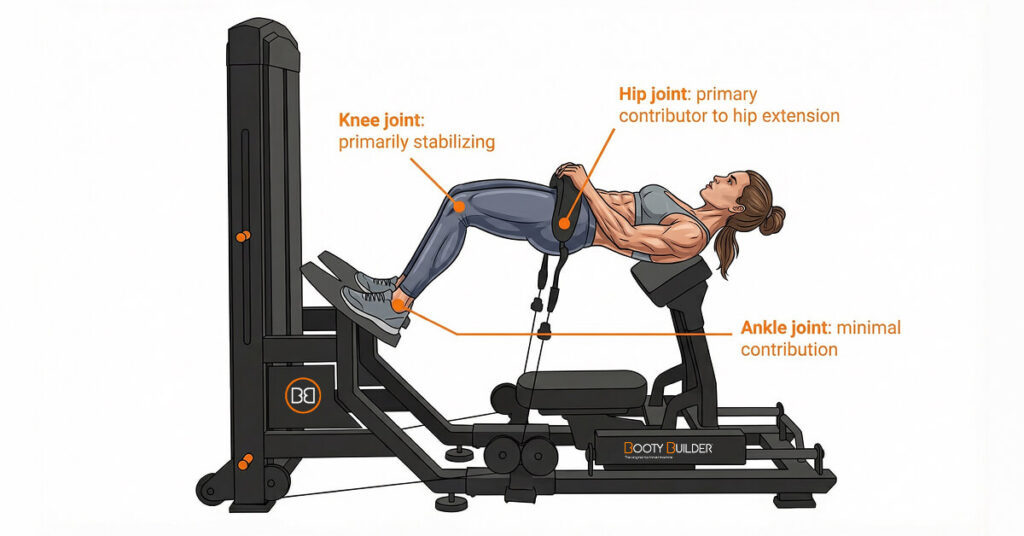
A practical advantage of hip thrusts is that the movement demands very little from the ankle compared with deep squatting patterns.
Why that matters:
- You can train the hip extensors hard without needing large ankle motion.
- For some lifters, that makes it easier to push intensity on glute work even if squats feel limited by ankle range, balance, or comfort.
Reality check: this doesn’t mean hip thrusts are “better than squats.” It means they’re a useful tool when you want a hip-focused stimulus without a lot of ankle contribution.
Benefit 3 — Efficient Progressive Overload for Glute Growth Blocks
The most reliable “benefit” in bodybuilding isn’t novelty, it’s progression.
Hip thrusts tend to be well-suited to progressive overload because:
- Loading is straightforward (plates, stack, or band resistance depending on the setup)
- The movement pattern is relatively repeatable once setup is dialed in
- You can scale from lighter, higher-rep work to heavy sets
Why this matters for hypertrophy-focused phases:
- Glute growth is driven by training that consistently delivers high effort and repeatable tension over time.
- Hip thrusts make it easier (for many people) to keep reps consistent and progressively challenge the same pattern week to week.
Benefit 4 — Potential Athletic Carryover to Horizontal Performance
Hip thrusts are often discussed in the context of sprinting and horizontal force production.
What the literature summary suggests:
- Some studies show acute improvements in sprinting performance after hip thrusts (often discussed under post-activation performance enhancement/potentiation).
- Training studies looking at longer-term sprint changes are mixed, some show improvements, others show no clear effect.
How to use that information intelligently:
- Hip thrusts can be a smart supporting lift for athletes who need hip extension strength.
- They are not a shortcut that replaces sprint practice, technique work, and sport-specific programming.
Benefit 5 — Hip Thrust Machines Often Overload the Glutes Better Than a Barbell (For Real-World Training)
For glute growth, the “best” exercise isn’t just the one where you lift the most weight, it’s the one where your glutes are the limiting factor. If your set ends because the bar is sliding, your back is uncomfortable, or the bench is tipping, you have left glute growth on the table.
Using a stable setup (like a purpose-built hip thrust machine) optimizes the physiological environment for hypertrophy in three ways:
- Elimination of “Energy Leakage”: When the weight is guided, your nervous system doesn’t have to “waste” energy on balancing the bar. This allows for higher motor unit recruitment—meaning you can actually push the muscle closer to true failure.
- Standardized Range of Motion (ROM): Machines allow you to lock in your foot and back position. This ensures that rep 1 and rep 10 are identical, making it easier to track genuine progress rather than just finding a “trick” to move a barbell more easily. Booty Builder’s hip thrust machines, for example, are designed around a raised footplate / positioning system intended to provide deeper ROM and easier setup.
- The “Mind-Muscle” Connection: High levels of external stability reduce the “threat” perceived by the nervous system. When you feel “locked in,” you can focus entirely on the internal cueing and the hard contraction at the top of the movement.
- Optimized Resistance Curves: A barbell’s resistance is constant, but your strength isn’t. Machines often use cams or levers to make the weight heaviest at the top of the rep, ensuring the glutes are under maximum tension exactly where they are strongest.
In a comprehensive biomechanical analysis of the barbell hip thrust, researchers found the hip extension moment decreases as the hip extends, reaching a local minimum near full extension, meaning the hip extensor demand is not maximized at end range in a standard barbell setup.
Key Difference: While a barbell is a fantastic tool for general strength, a machine is often the superior tool for targeted hypertrophy because it removes the logistical distractions that stop a set before the muscle is actually finished.
Benefit 6 — A Strong Complement to Squats and Deadlifts
Hip thrusts don’t need to replace big lower-body lifts to be valuable.
They pair well with squats and hinges because they can:
- Add targeted hip extension volume without repeating the exact same loading pattern
- Emphasize hip extension in a way that feels different from vertical patterns
- Help keep your weekly glute training more complete across exercises
Simple programming logic (conceptual):
- Use squats/lunges for large ranges, multi-joint challenge, and overall leg development
- Use hinges for posterior chain strength through longer muscle lengths
- Use hip thrusts to hammer hip extension with a stable setup you can overload reliably
Who Should Prioritize Hip Thrusts
Hip thrusts are especially useful if you:
- Want a more direct glute-focused lift to drive progressive overload
- Need a hip-dominant option that doesn’t demand much from the ankle
- Want a lower-body movement that isn’t limited by grip strength
- Prefer stable, repeatable training (machines make this even easier)
- Want to add glute volume without turning every session into maximal systemic fatigue
How to Actually Get the Benefits (Without Turning It Into Low Back Work)
This is not the full form guide, but these checkpoints determine whether hip thrusts deliver the benefits above:
- Lock out with glutes, not lumbar overextension (ribs stacked over pelvis at the top)
- Keep foot pressure stable (no shifting, no rocking)
- Repeat the same range of motion every rep and every set
- Progress something over time (load, reps, control, or total quality volume)
Key Takeaways
- Hip thrusts are a high-ROI tool for developing hip extension strength and glute-focused overload.
- They typically involve minimal ankle contribution, helping keep the effort where you want it: the hips.
- Athletic carryover (like sprint performance) is plausible and supported in some contexts, but training-study results are mixed—use hip thrusts as a supplement, not magic.
- Machines are a major advantage for most lifters because they improve comfort, setup speed, and repeatability-key drivers of long-term progress.