

Deadlift Muscles Worked: Glute vs Hamstring Bias
Why Deadlifts Feel Like Glutes for Some People and Hamstrings for Others
Two lifters can deadlift the same load and walk away with totally different “where I felt it” results, glutes, hamstrings, quads, or lower back..
That’s because the deadlift is a whole-body hinge, not a single-muscle movement. Small changes in knee bend, hip hinge depth, and torso position change how much each muscle group contributes. If you understand the simple “bias dials,” you can make your deadlift more glute-leaning or hamstring-leaning on purpose, without turning it into a different exercise.
What You’ll Learn in This Article
- The main muscles worked in deadlifts (beyond just glutes/hamstrings)
- The three primary hip extensors and what they each contribute
- The #1 glute vs hamstring bias lever: knee angle + hinge depth
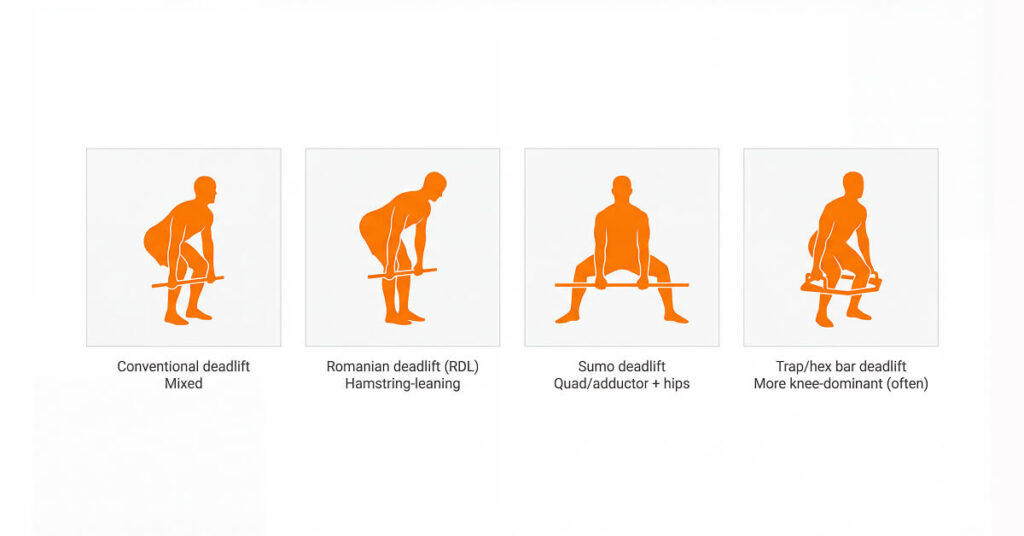
- What different deadlift styles tend to emphasize (conventional, RDL-style, sumo, trap bar)
- How machines make muscle emphasis easier to standardize and repeat
Deadlift Muscles Worked
If you only track “glutes vs hamstrings,” you’ll miss what deadlifts actually train.
Deadlifts load multiple joints at once, so multiple muscle groups contribute.
Primary contributors (most people will feel these):
- Hip extension: gluteus maximus, hamstrings, and the hip-extending portion of adductor magnus
- Knee extension (especially off the floor / deeper starts): quadriceps
- Torso stiffness / posture: spinal erectors + trunk bracing muscles
- Keeping the load close: lats and upper back
- Grip and bracing endurance: forearms/hands + trunk
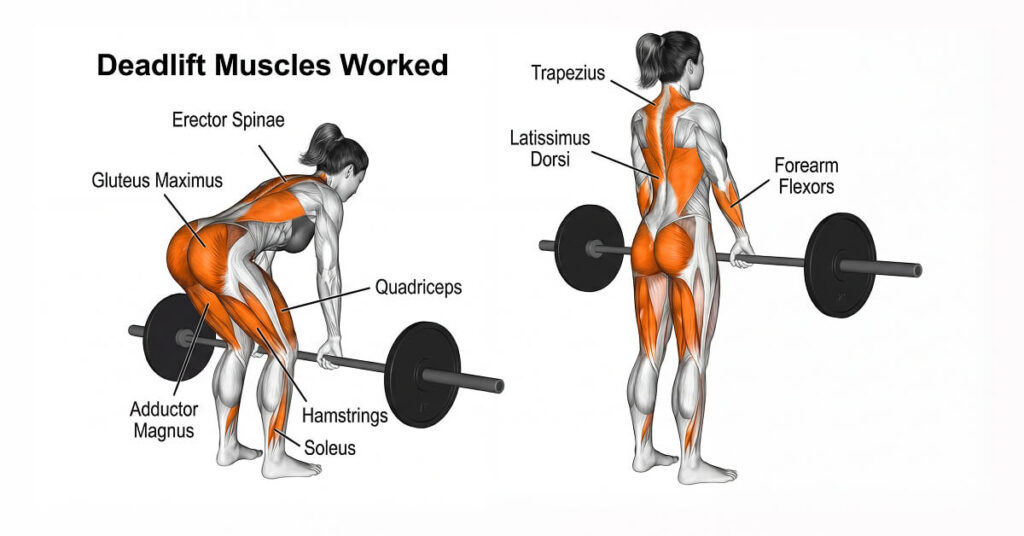
Practical takeaway:
Deadlifts are often a “posterior chain” exercise in intention, but they still commonly involve meaningful quad and back demand depending on your style and depth.
The Three Main Hip Extensors in Deadlifts
Glute vs hamstring bias starts with knowing which muscles actually extend the hip.
Gluteus maximus (monoarticular hip extensor)
- Main job: driving hip extension and finishing the lift to a tall lockout
- Since it crosses the hip (not the knee), it’s less affected by knee angle changes than the hamstrings are.
Hamstrings (biarticular hip extensor + knee flexor group)
- Most hamstrings cross both the hip and knee (the biceps femoris short head is the main exception).
- That matters because changing knee angle changes hamstring length/tension and can shift how “hamstringy” a deadlift feels.
Adductor magnus (often overlooked)
- Adductor magnus isn’t “only inner thigh.” It has a portion that can assist hip extension (especially the hamstring/ischiocondylar portion).
- This is one reason some deadlift styles (particularly wider stances) can feel more “adductors + hips.”
The Glute vs Hamstring Bias Dials
You can’t isolate glutes or hamstrings in a deadlift, but you can shift which one becomes the limiting factor.
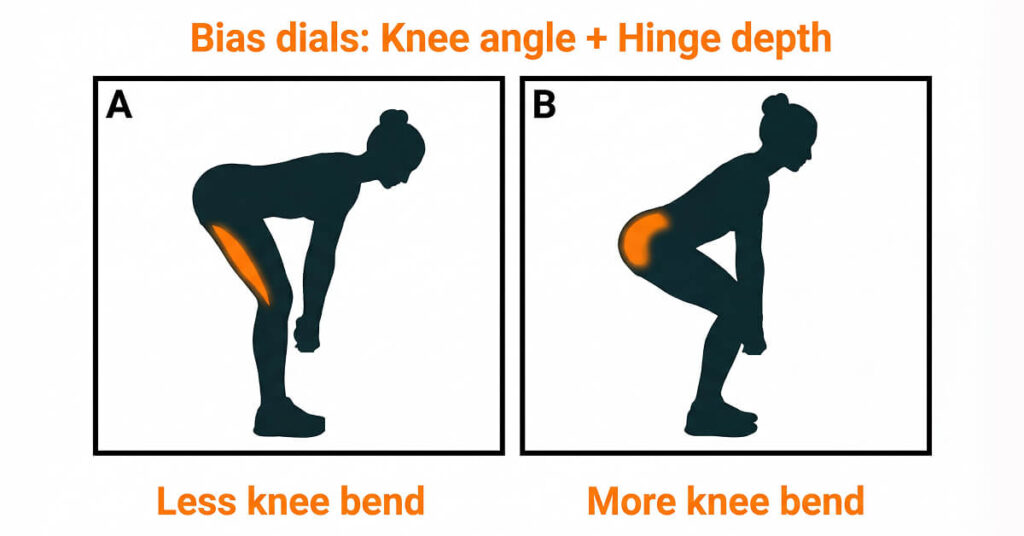
Dial #1: Knee bend (more bend vs more straight)
Because the hamstrings cross the knee, knee angle changes their length and often changes what you feel.
More knee bend tends to shift demand away from “pure hamstring stretch”
- Often feels more “legs + hips” (quads + glutes + adductors depending on stance)
- Commonly easier to keep position for many lifters at the start
Less knee bend tends to increase hamstring tension
- Often feels more “posterior chain stretch”
- Requires stricter hinge control to keep torso position consistent
Dial #2: Hinge depth (how much hip flexion you use)
More hip flexion increases length-demand on hip extensors in general (glutes + hamstrings).
What changes the bias is how that depth is paired with knee angle:
- Deep hinge + less knee bend tends to feel most hamstring-loaded
- Deep hinge + some knee bend often feels more glute/adductor-friendly while still loading posterior chain heavily
Dial #3: Stance and implement (secondary, but real)
- Wider stance and more toe-out often increases “adductor + hips” involvement for many lifters
- Trap/hex bar setups commonly shift demand toward the knees compared with straight-bar mechanics
- These aren’t “better or worse”, they’re tools to match your goal and your body
What Research Suggests About Activation Patterns in Deadlift Variations
People assume deadlifts are “mostly glutes and hamstrings,” but measured muscle activation often shows a broader picture.
Surface EMG studies don’t tell you exactly which muscle will grow the most, but they are useful for understanding how different deadlift styles shift muscular demands.
Electromyographic activity in deadlift exercise and its variants: a systematic review (open access)
Key takeaways that matter for programming (simple and honest):
- Across many studies, quadriceps and erector spinae often show high activation in deadlift variations (not just glutes/hamstrings).
- Romanian deadlift patterns are often associated with lower erector spinae activation relative to hamstrings compared with some other styles.
- Within the hamstrings, semitendinosus is frequently reported as slightly more activated than biceps femoris in deadlift variants.
How to Make Your Deadlift More Glute-Biased
A glute-biased deadlift still trains hamstrings; it just sets the lift up so glutes can contribute more consistently.
Glute-bias setup cues
- Keep some knee bend instead of drifting into a stiff-leg pattern
- Think “push the floor away” so hips and knees extend together (not hips shooting up first)
- Keep the load close (bar/handles close to your body) so hip extension stays efficient
- Finish by “standing tall” (don’t over-lean back at lockout)
Glute-bias variation tendencies (not absolutes)
- Conventional deadlift often gives more “whole-leg + glute” loading than RDL-style hinges
- Sumo often increases quad/adductor demand and can still load glutes strongly, especially in higher knee flexion ranges
- Trap/hex bar often feels more knee-dominant for many lifters (more “legs”)
How to Make Your Deadlift More Hamstring-Biased
Hamstring bias usually means: more hinge tension, consistent knee angle, and control.
Hamstring-bias setup cues
- Maintain a soft knee (not locked), but avoid adding more knee bend as reps get hard
- Push hips back and keep shins more vertical
- Control the eccentric (lowering) so tension stays where you want it
- Keep the torso position rigid—if your back position changes, you’ve lost the bias
Hamstring-bias variation tendencies
- Romanian deadlift style typically increases hamstring tension because knee angle is more fixed and the hinge is emphasized
- Stiff-leg patterns can increase hamstring length demand further (but require strict control)
Why Machines Make Glute vs Hamstring Bias Easier to Repeat
Machines don’t “replace technique.” They reduce variables so the same setup is easier to reproduce session after session.
On a deadlift machine, you can usually standardize the two bias dials more easily:
- Start position: consistent depth and handle height
- Foot pressure and stance: stable platform
- Rep repeatability under fatigue: fewer moving parts than a floor setup
How to use a machine to bias intentionally
- More glute-leaning: slightly more knee bend + controlled depth you can repeat
- More hamstring-leaning: slightly less knee bend + deeper hinge you can control without torso position changing
A well-designed deadlift machine (including Booty Builder-style setups) makes it easier to keep the hinge consistent, so your target emphasis comes from your chosen knee angle and depth, not from a setup that changes every session.
Key Takeaways
- Deadlifts train hips + knees + trunk, not just glutes and hamstrings.
- Glute vs hamstring bias is mostly controlled by knee angle + hinge depth.
- More knee bend usually reduces hamstring stretch-tension and increases “legs + hips” involvement.
- Less knee bend and a stricter hinge usually increases hamstring tension.
- Machines can make bias easier to repeat because setup and start position are more standardized.