

Deadlift Benefits
Deadlifts Build More Than “Back Strength”
Many people either avoid deadlifts because they associate them with back stress, or they treat them as a powerlifting-only lift. Both miss the point.
A well-executed deadlift is a hip hinge + full-body brace. It trains the ability to produce hip extension force while keeping the torso rigid and the load close. That combination is why deadlifts can be such a high-impact tool for strength and physique goals, especially when you choose the right variation (barbell or machine), load, and range of motion for your body and training focus.
What You’ll Learn in This Article
- The most “real” benefits deadlifts provide (strength, muscle, performance, efficiency)
- Why deadlifts are a posterior-chain builder, but not a glute-only exercise
- How deadlifts improve your ability to brace and hold position under load
- Why machines can make hinge training easier to standardize and progress
- How to get the benefits without turning deadlifts into a lower-back-dominant grind
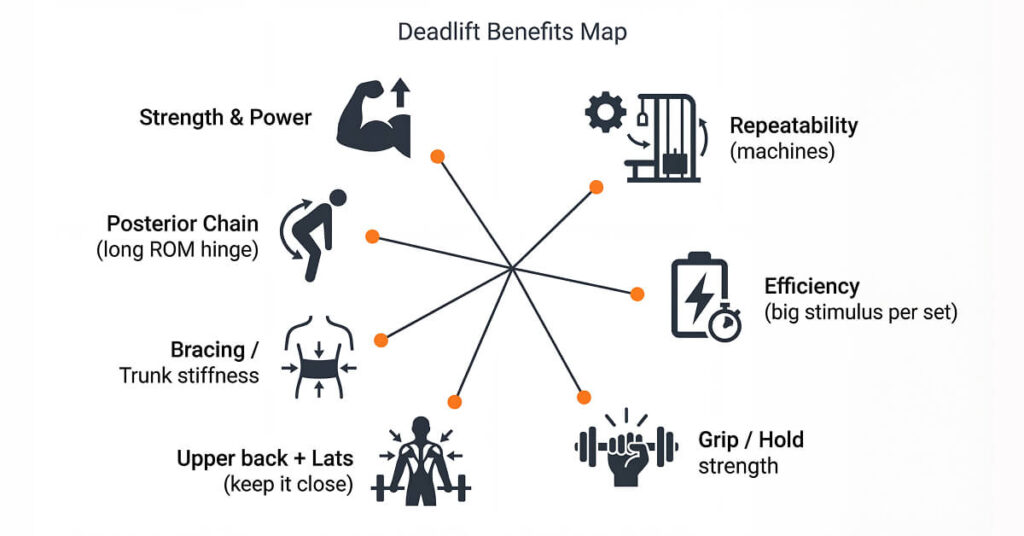
Benefit 1: Higher Lower-Body Strength and Power Potential
Deadlifts are one of the clearest ways to build “from-the-ground-up” strength because they let you train hip and knee extension under heavy, full-body tension.
What evidence supports (in plain terms)
A 6-week study in resistance-trained men compared a program where the only lower-body maximal strength lift was deadlift vs a program where it was parallel squat. Both programs also included jumps. The deadlift-focused group improved deadlift 1RM more, and jump performance improved in both groups. The authors concluded both lifts can be successfully included to improve lower-body maximal strength and power in that training context.
How to actually capture this benefit
- Use deadlifts as a main lift when you can repeat clean reps and progressively overload
- Treat technique as a performance skill (if reps change shape under fatigue, your “benefit per set” drops fast)
- If you want “power” outcomes, deadlifts are usually paired with intent (fast concentric) and/or complementary explosive work
Benefit 2: Posterior Chain Development Through a Long Range of Motion
Deadlifts are one of the best tools for training the hip extensors in a more lengthened hinge position, something many glute-focused programs need.
Deadlifts load the muscles that extend the hip (gluteus maximus, hamstrings, and adductor magnus contribution) while also demanding trunk stiffness. Unlike hip thrust variations (which emphasize peak tension closer to lockout), many deadlift styles create substantial demand during deeper hip flexion—useful for building strength and muscle across a different part of the range.
Why this matters for glute-focused training
- Glutes don’t just need “squeeze work” (shortened bias)
- They also benefit from progressive tension in deeper hip flexion (hinge patterns)
- A glute-complete plan often includes both a hinge (deadlift/RDL pattern) and a thrust/bridge pattern
How to keep deadlifts glute-relevant
- Choose a hinge depth you can control without losing trunk position
- Use variations that match your goal (conventional for whole-body strength, RDL-style for more hinge tension)
- Don’t let grip or setup chaos cap your posterior-chain work (machines and/or straps can help here)
Benefit 3: Better “Real Lifting” Mechanics
Deadlifts reward efficiency: load stays close, torso stays rigid, hips do the work.
Even if you never compete, deadlifts train a skill that matters in real life: picking something up while keeping it close to your body, bracing, and using the hips and legs to move it. The lift builds capacity in the exact “hinge + brace” pattern that shows up in many daily tasks.
The simplest transfer rule
The closer the load is to your body, the more efficient the lift tends to be. Deadlifts train that “keep it close” habit every rep.
Benefit 4: Trunk Bracing and Upper-Back Strength in One Lift
Deadlifts aren’t just a hip exercise; they also train your ability to resist position change under load.
A major benefit of deadlifts is the isometric demand: holding spinal and ribcage position while force is produced at the hips and knees. Your lats and upper back also work hard to keep the load from drifting forward and to keep your torso connected to the implement.
Why this matters practically
- Better bracing often makes every lower-body lift feel more stable
- Better “hold strength” can improve consistency rep to rep (especially at higher loads)
Benefit 5: Grip Strength and “Hold Strength” (Plus an Easy Workaround)
For many lifters, grip is either a benefit or a bottleneck that hides the real posterior-chain stimulus.
Barbell deadlifts are a legitimate grip-builder because the hands must hold the load for every rep. But if your goal is glutes/hamstrings, grip failure can stop the set before the target muscles are truly challenged.
How to choose based on your goal
- If grip development is a priority: keep some barbell pulling in the plan
- If posterior chain hypertrophy is the priority: it’s reasonable to use straps on some work, or use a machine/handles that reduce grip as the limiter
- Either way, the hinge pattern is still trained; only the limiting factor changes
Benefit 6: High Training Efficiency (Big Stimulus per Set)
Deadlifts give you a lot of return because they involve multiple large muscle groups at once.
If time is limited, deadlifts can cover a wide training base quickly: hips, legs, trunk, upper back, and grip. That efficiency is also why fatigue management matters, because deadlifts are “expensive,” you typically don’t need endless volume to benefit.
The practical advantage
A few high-quality hinge sets can complement a glute-focused week without needing a long menu of extra exercises.
Benefit 7: Machines Make High-Quality Hinge Training Easier to Repeat
Machines don’t change the goal. They make the setup more repeatable, so more of your effort goes into the rep instead of the logistics.
A deadlift machine can be a major advantage when you want consistent start positions and clean reps under fatigue.
What a deadlift machine standardizes
- Foot platform stability and stance repeatability
- Handle height / start position (which affects range of motion and hinge depth)
- Faster setup and smoother progression between sets
Where Booty Builder-style machines fit
Booty Builder’s Selectorized Deadlift/split squat is designed for deadlifts, RDLs, and good mornings, and includes a large foot platform, multiple handle options, and height/position adjustments to help different lifters match the setup to their body. Practically, that makes it easier to:
- Practice the hinge pattern with consistent mechanics
- Accumulate posterior-chain volume with less setup friction
- Keep the start position repeatable when fatigue rises
(You still need good bracing and controlled reps, but the machine can make that easier to reproduce.)
Getting the Benefits Without Turning Deadlifts Into a “Survive the Set” Exercise
Deadlifts reward discipline: clean positions, smart loading, and stopping sets when form changes.
Even strong lifters can lose technique when fatigue spikes. In the study linked earlier, a few participants in the deadlift group reported low back pain and were excluded, an important reminder that progressive loading must be paired with technique control.
Simple rules that protect the benefit-to-fatigue ratio
- Stop sets at technical failure (when the rep changes shape)
- Keep the load close and brace before every rep
- Use the variation that lets you maintain your hinge and torso position
- Use machines when consistency or setup variability is limiting your quality
Key Takeaways
- Deadlifts build full-body strength by training a heavy hip hinge with a rigid torso.
- They’re a powerful posterior-chain tool, especially for training hip extension through a larger hinge range.
- Deadlifts also train bracing, upper-back tension, and (often) grip.
- Machines can make hinge training more repeatable and time-efficient, helping you get more high-quality reps per session.
- The benefits come from consistent, repeatable reps, not from surviving ugly grinders.