

Split Squat Knee Pain Fixes
Split Squat Knee Pain Is Usually a Setup or Tolerance Problem
Split squats can feel uncomfortable fast when stance length, depth, balance, or rear-foot position is slightly off.
That does not mean split squats are bad for your knees. It usually means the current version of the exercise is asking for more knee control, range, or load tolerance than you can repeat cleanly right now. The fix is not always to remove the exercise. Often, the better answer is to adjust the setup so the front leg can work hard without the knee becoming the limiting factor.
This page is for common training-related knee discomfort, not acute injury diagnosis. If pain is sharp, worsening, swollen, unstable, or related to a traumatic incident, get assessed by a qualified clinician.
What You’ll Learn in This Article
- Why split squats can irritate the front knee even when the exercise is useful
- How stance length changes knee demand
- How to adjust depth without losing the training effect
- Why rear-foot height and rear-leg push-off can create knee problems
- How torso angle can shift stress between knee and hip
- Why machine support can make split squats more knee-friendly and more loadable
- A quick troubleshooting checklist for your next set
First Identify When the Knee Pain Happens
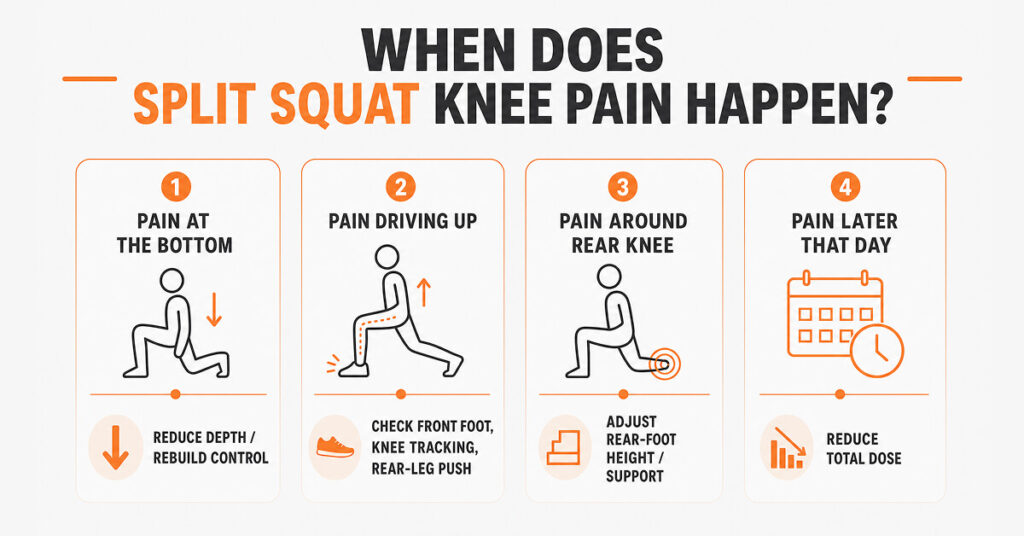
Before changing everything, notice where in the rep the discomfort appears.
The timing of the pain usually gives you the best clue for which setup variable to adjust first. You are not trying to diagnose yourself; you are simply narrowing down what part of the movement is not tolerated well.
Pain at the bottom
This often means the current depth, knee angle, or stance length is too aggressive. The first fix is usually to reduce range slightly and rebuild control.
Pain as you drive up
This often means the front foot is losing pressure, the knee is collapsing inward, or the rear leg is pushing you out of position.
Pain around the rear knee
This is often a rear-foot setup issue, especially in rear-foot-elevated split squats. The rear foot may be too high, too far behind you, or placed on an uncomfortable surface.
Pain that shows up later
If the knee feels fine during the set but worse later that day or the next day, the total dose may be too high. Reduce load, depth, sets, or frequency before assuming the exercise is wrong.
Fix 1: Make the Front Foot the Base
The front foot should feel planted, not like it is searching for balance.
If the front foot is unstable, the knee has to manage extra motion every rep. That can make a good split squat feel irritating even at moderate loads.
What to look for
- Heel lifting
- Big toe losing contact
- Foot rolling inward
- Weight shifting backward into the rear leg
- Knee wobbling as you change direction
How to fix it
Use a “tripod foot” idea:
- heel stays down
- big toe stays connected
- outside edge of the foot stays connected
- knee tracks in the same direction as the toes
Do not overcorrect by forcing the knee outward aggressively. The goal is smooth knee tracking, not a stiff or exaggerated position.
Fix 2: Adjust Stance Length Before You Blame the Exercise
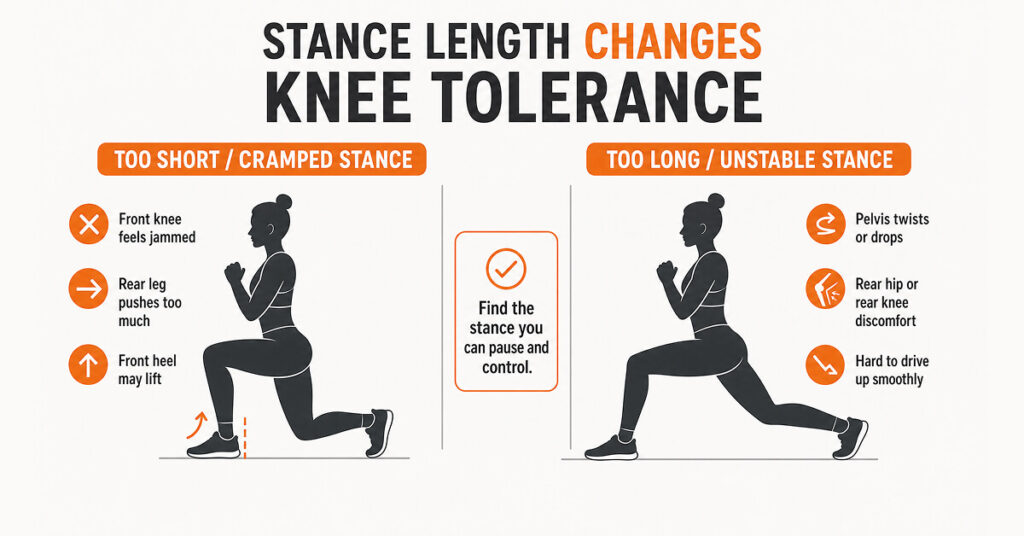
Stance length is one of the biggest split squat knee-pain levers.
A stance that is too short often creates a cramped, knee-dominant rep. A stance that is too long can make balance and rear-hip tension the limiter. Neither is automatically wrong, but both can cause problems when they do not match your current control.
If the stance is too short
Common signs:
- front knee feels jammed
- rear leg pushes too much
- front heel wants to lift
- the movement feels like a narrow, unstable knee bend
Try moving the front foot slightly farther forward. Small changes matter. Start with one shoe-length or less.
If the stance is too long
Common signs:
- you feel stretched or unstable
- pelvis twists or drops
- rear hip or rear knee feels uncomfortable
- you cannot drive up smoothly
Try shortening the stance slightly until you can lower and stand without shifting.
The best stance test
At the bottom, you should be able to briefly pause while keeping:
- front foot planted
- knee tracking cleanly
- pelvis controlled
- rear leg supportive, not dominant
If you cannot pause there, the stance is not yours yet.
Fix 3: Use the Deepest Range You Can Control Today
Depth is useful only if the knee can tolerate and control it.
You do not need to remove depth forever. But if your knee is irritated, forcing the same deep split squat every session can keep symptoms around. Temporarily reducing range can let you keep training while you rebuild tolerance.
How to reduce range without making the exercise pointless
Use one of these options:
- stop 1–2 inches above the painful depth
- use a small target pad for consistent depth
- slow the descent so you are not dropping into the bottom
- keep the same range on every rep instead of cutting depth as fatigue builds
When to rebuild depth
Add depth back gradually when:
- pain stays low during the set
- symptoms do not worsen later
- knee tracking remains consistent
- you can pause at the bottom without bouncing
The goal is not shallow forever. The goal is controlled range that your knee can currently tolerate.
Fix 4: Change Torso Angle to Shift the Stress
A split squat can feel very different depending on how upright or hip-driven you make it.
A very upright torso usually increases the knee-dominant feel. A slight forward torso angle often shifts more of the work toward the hip and glute. That can be useful when the front knee is irritated.
If the front knee feels overloaded
Try:
- a slightly longer stance
- a slight forward torso lean
- pushing through the full front foot
- controlling the bottom instead of bouncing
This can make the rep feel more hip-driven without turning it into a different exercise.
What not to do
Do not fold forward so much that the lower back or balance becomes the limiter. The torso angle should help the front leg work better, not turn the split squat into a messy hinge.
Fix 5: Stop the Rear Leg From Taking Over
The rear leg can quietly change the entire exercise.
When the rear leg pushes too hard, it can shift the body forward, change the front knee path, and make the set feel inconsistent. In rear-foot-elevated split squats, rear-foot discomfort can also make you move oddly just to avoid pressure.
Signs the rear leg is causing problems
- rear quad or rear hip flexor burns more than the front leg
- front foot feels light during the ascent
- you bounce off the rear leg at the bottom
- knee pain appears only in rear-foot-elevated versions
- rear knee or top of the rear foot feels irritated
Fix the rear-foot setup
Try:
- lowering the rear-foot support
- using a softer or rounded pad
- moving the front foot slightly forward
- keeping the rear leg relaxed
- using handles or machine support so the rear foot is not your main balance strategy
The rear leg should feel like a kickstand, not a second engine.
Fix 6: Slow the Eccentric and Remove the Bounce
Bouncing out of the bottom can make the knee absorb the rep instead of controlling it.
A controlled lowering phase makes the split squat easier to standardize. It also shows you whether the knee can actually tolerate the position, instead of relying on momentum to pass through it.
Use this tempo first
A simple knee-friendly starting tempo:
- lower for 2–3 seconds
- pause briefly if needed
- drive up smoothly
- stop the set before reps change shape
What this fixes
Slowing down often reduces:
- bottom-position collapse
- knee wobble
- rear-leg push-off
- inconsistent depth
- bouncing through painful ranges
Tempo is not magic. It just makes the rep more honest.
Fix 7: Use Support or a Machine to Remove Unnecessary Instability
Support is not cheating if it lets the target leg do better work.
A common mistake is assuming split squats become better when they are harder to balance. That is not always true. If balance fails before the front leg is challenged, the exercise becomes a coordination test instead of a productive lower-body lift.
Hand support can improve the exercise
Lightly holding a rack, handles, or machine support can help you:
- keep the pelvis square
- keep the knee tracking cleanly
- stop the rear leg from taking over
- use a deeper controlled range
- load the front leg harder
The goal is not to pull yourself up. The goal is to remove unnecessary wobble.
Why machine-supported split squats are often the best fix
On the Booty Builder Selectorized Deadlift/Split Squat setup, the padded rear-foot support, large platform, multiple handle positions, adjustable settings, and selectorized resistance make the split squat easier to repeat.
That matters for knee pain because you can control:
- rear-foot height
- stance length
- front-foot position
- balance support
- depth
- loading increments
The machine does not make the front leg work less. It makes the setup more stable so the front leg can work harder with fewer unwanted variables.
Quick Troubleshooting Guide
Use this before your next set instead of guessing.
If the front knee hurts at the bottom
Try:
- reduce depth temporarily
- slow the descent
- adjust stance slightly longer
- use machine or hand support
- pause above the painful range
If the front knee caves inward
Try:
- reduce load
- keep tripod foot pressure
- use a controlled tempo
- use handles for balance
- stop the set before fatigue changes tracking
If the rear knee hurts
Try:
- lower the rear-foot support
- use a softer pad
- shorten the stance slightly
- switch to a standard split squat temporarily
- use a machine with a better rear-foot support
If pain appears after training
Try:
- reduce total sets
- reduce load
- reduce depth temporarily
- avoid taking sets close to failure
- progress only one variable at a time
When to Stop and Get Assessed
Not every knee symptom should be trained through.
Stop the session and get professional advice if you have major swelling, locking, giving way, severe pain, inability to bear weight, visible deformity, numbness/tingling, or pain that keeps worsening despite reducing load and range. Those are not normal split squat technique issues.
Key Takeaways
- Split squat knee pain is often caused by setup, stance length, depth,
- balance, or rear-leg contribution—not the exercise itself.
- The front foot should stay planted and stable so the knee can track cleanly.
- Stance length matters: too short can feel cramped and knee-dominant; too long can create instability and rear-leg discomfort.
- Use the deepest range you can control today, then rebuild depth gradually.
- A slight forward torso angle can often reduce the knee-dominant feel and shift more work toward the hip.
- Machine-supported split squats are a strong solution because they make rear-foot position, stance, depth, and loading easier to repeat.