

Split Squat Benefits
Why Split Squats Add Something Bilateral Squats Cannot
A bilateral squat can build tremendous lower-body strength, but it cannot show as clearly how each leg performs on its own.
The split squat gives each side a more independent training role while keeping both feet supported. This creates a useful middle ground: more unilateral emphasis than a regular squat, but more stability than a true single-leg squat. Technically, split squats are best described as unilateral-biased, because the rear leg still contributes support and some mechanical resistance. The main benefit is that one front leg receives a much larger share of the training demand at a time.
What You’ll Learn in This Article
- Why split squats are effective for unilateral strength and muscle growth
- How they challenge one leg without requiring enormous total loads
- Why they make side-to-side differences easier to identify
- What unilateral training can—and cannot—transfer to athletic performance
- Why stability and hand support can improve the exercise rather than weaken it
- How a purpose-built machine turns split squats into a serious progressive-overload exercise
Benefit 1: Build Lower-Body Strength One Side at a Time
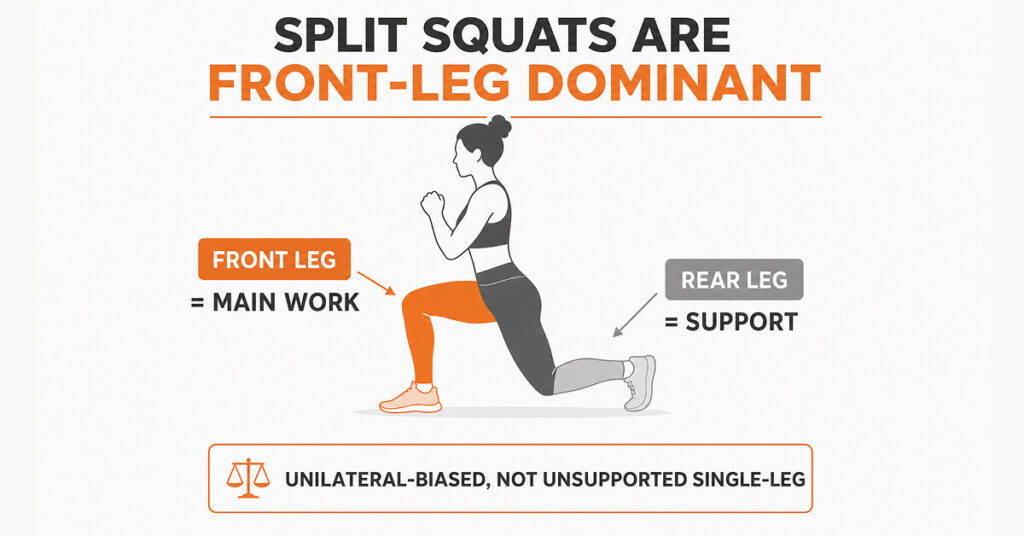
Split squats let you develop strength in a unilateral pattern instead of relying only on both legs working together.
That distinction matters because strength gains are specific to the task being trained. A 2025 systematic review and meta-analysis comparing unilateral and bilateral resistance training found that unilateral training produced greater improvements in unilateral strength, while bilateral training produced greater improvements in bilateral strength. Neither method was universally superior; each was best at improving the type of strength it trained.
Why unilateral strength matters
Many everyday and athletic movements involve one leg accepting or producing more force than the other. Split squats let you load that ability directly without requiring the movement and balance demands of running, jumping, or stepping.
This makes the exercise useful for:
- Building front-leg force production
- Developing strength in each leg separately
- Adding unilateral work alongside bilateral squats and deadlifts
- Training one side without relying on the opposite leg to contribute equally
Split squats complement rather than replace bilateral strength
Split squats are not automatically better than regular squats. A bilateral squat remains more specific when the goal is maximal bilateral squat strength. The split squat earns its place because it develops a different strength quality: producing force primarily through one working leg.
Benefit 2: A Legitimate Exercise for Glute and Leg Growth
Split squats should not be treated as a light balance drill performed after the “real” exercises.
They are a loadable, multi-joint exercise that challenges hip and knee extension in the front leg. Depending on stance and torso position, the split squat can provide substantial demand for the gluteus maximus, quadriceps, and adductor magnus. Its unilateral structure does not reduce its muscle-building value.
Unilateral training can build as much muscle as bilateral training
The 2025 meta-analysis cited above found no significant difference in muscle hypertrophy between unilateral and bilateral resistance training. The available evidence was limited and included different exercises, not split squats alone. Still, it supports an important conclusion: using one leg at a time does not inherently make an exercise inferior for muscle growth.
Why split squats work well in glute-focused training
Split squats combine:
- Meaningful hip flexion at the bottom
- Hip extension as the front leg drives upward
- Knee extension from the quadriceps
- Frontal-plane and rotational control around the hip and pelvis
That combination makes them a broad lower-body builder rather than an isolation exercise.
Benefit 3: Challenge One Leg Without Requiring Enormous Total Loads
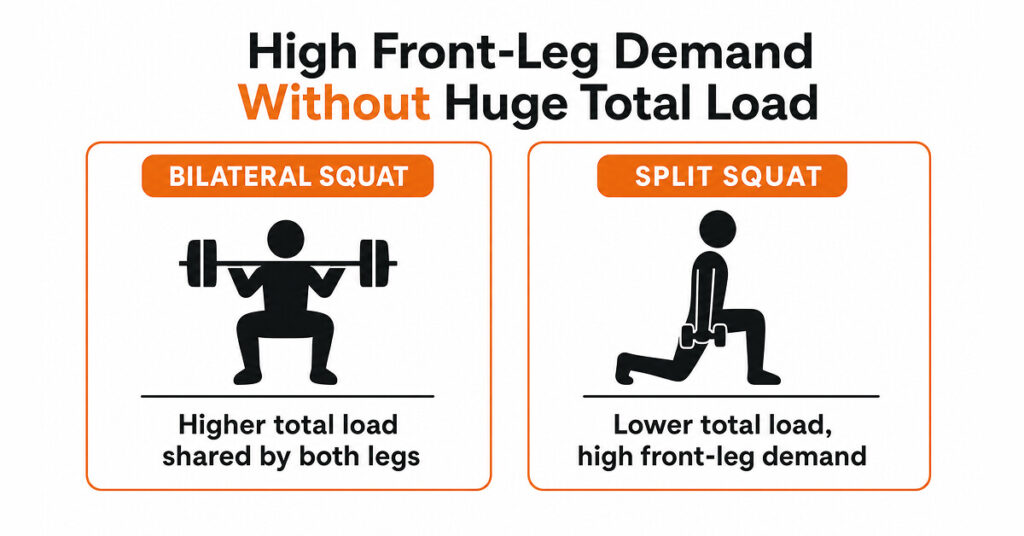
Split squats can create a large local challenge before the total external load becomes extreme.
In one acute study, rear-foot-elevated split squats performed with 50% of the back-squat load produced similar activity in most of the muscles measured and similar peak vertical force to the bilateral back squat. This does not prove identical long-term growth or guarantee lower spinal stress, but it demonstrates how hard one leg can work with a smaller total external load.
Why this is useful in practice
A smaller total external load can make it easier to:
- Challenge each leg without placing a very large barbell on the body
- Add demanding lower-body work after another compound lift
- Progress the working leg when bilateral loading is limited by the upper back or setup
- Train hard with dumbbells, selectorized resistance, or other compact loading methods
“Less total load” does not mean “easy.” The front leg can still experience a very high relative demand.
What this benefit does not mean
It would be inaccurate to claim that every split squat automatically creates less fatigue, less spinal stress, or more muscle growth than every bilateral squat. Those outcomes depend on the variation, external load, range of motion, support, effort, and individual lifter.
The defensible benefit is narrower: split squats can create a demanding front-leg stimulus without needing the same total external load as a bilateral squat.
Benefit 4: Make Side-to-Side Differences Easier to See
When both legs work together, the stronger or more coordinated side can sometimes contribute more without being obvious.
Split squats give each side its own set, making differences in strength, control, range of motion, and confidence easier to observe. You can see whether one leg reaches fewer repetitions, requires a lighter load, loses alignment sooner, or struggles to reproduce the same depth.
Visibility is the real benefit
Split squats can reveal:
- Differences in usable strength
- Differences in pelvic or knee control
- Different ranges of motion between sides
- Different rates of fatigue
- Unequal confidence under load
That information can help guide training decisions.
Split squats do not automatically “fix imbalances”
Not every difference between sides is a problem, and simply performing unilateral exercises does not guarantee that an asymmetry will disappear. The useful feature is that each side can be trained, measured, and progressed more independently instead of allowing one combined number to hide the difference.
Benefit 5: Train Unilateral Control Without Standing on One Leg
The split stance creates a stability challenge, but it still gives you a larger base of support than a true single-leg squat.
Both feet remain supported, allowing the front leg to receive most of the training emphasis while the rear leg helps maintain position. This makes the split squat a practical way to train unilateral-biased hip and knee extension without requiring balance to the same degree as unsupported single-leg exercises.
What the body has to control
The split stance requires control of:
- Front-knee tracking
- Pelvic rotation and side-to-side movement
- Foot and ankle pressure
- Torso rotation and lateral bending
- Force distribution between the front and rear legs
These demands distinguish split squats from bilateral squats, even when both exercises train many of the same prime movers.
More instability is not always more beneficial
The goal is not to make the exercise as unstable as possible. Excessive instability can reduce usable force and make balance fail before the glutes and quadriceps are fully challenged.
A stable floor, light hand support, or a purpose-built machine can therefore improve the exercise. Stability lets you direct more effort into the working leg instead of wasting it on preventing a fall.
Benefit 6: Useful for Unilateral Athletic Force Production
Many sports involve accelerating, jumping, landing, or changing direction with one leg contributing more than the other.
A systematic review and meta-analysis comparing unilateral and bilateral training found that unilateral training produced a larger improvement in unilateral jump performance, while bilateral training was better for bilateral strength. However, the review found no significant overall differences for sprint speed or change-of-direction performance. Split squats can therefore support unilateral force capacity, but they should not be presented as a substitute for sprinting, jumping, landing, or sport-specific practice.
The realistic performance benefit
Split squats can help develop the strength base used in unilateral tasks. Transfer is most likely when the exercise is combined with the actual skill being improved.
For an athlete, that could mean:
- Split squats for unilateral strength
- Jumps for explosive force application
- Sprints for sprint mechanics and speed
- Change-of-direction drills for braking and redirection skill
The strength exercise supports the performance task; it does not replace it.
Benefit 7: Machine Support Makes Heavy Split Squats More Productive
A machine-supported split squat is not a regression. It can be the best version when the goal is loading the working leg as hard and consistently as possible.
The Booty Builder Selectorized Deadlift/Split Squat provides a padded rear-foot support, a large platform, multiple hand positions, adjustable settings, and selectorized resistance. This creates a stable environment where stance, rear-foot height, balance support, and loading can be repeated from one set to the next.
Stability increases usable output
When the handles and rear-foot support remove unnecessary wobbling, the exercise can be loaded seriously. More of the lifter’s effort can go toward:
- Driving through the front leg
- Controlling a deep range of motion
- Maintaining pelvic position under fatigue
- Progressing load and repetitions consistently
- Taking the target muscles close to their actual limit
The machine does not make the front leg work less. It reduces the chance that balance, rear-foot discomfort, or equipment setup ends the set first.
Selectorized loading improves progression
Quick resistance changes make it easier to:
- Use different loads for the right and left sides when necessary
- Perform warm-up and working sets without rebuilding the setup
- Progress in controlled increments
- Keep the same stance and range while the load changes
That repeatability is especially valuable for hypertrophy, where meaningful progress depends on comparing similar reps across many weeks.
Split Squats and Bilateral Squats Solve Different Problems
There is no need to choose one movement family and reject the other.
Bilateral squats are excellent for producing force with both legs together and handling large total loads. Split squats are excellent for front-leg emphasis, unilateral strength, side-to-side visibility, and creating a high local stimulus without requiring the same total load. The most complete lower-body training plans often use both qualities rather than expecting one exercise to provide everything.
Key Takeaways
- Split squats develop unilateral-biased lower-body strength while retaining support from both feet.
- They are a legitimate hypertrophy exercise; current evidence does not show unilateral training produces less muscle growth than bilateral training.
- One leg can receive a high training demand without requiring the same total external load as a bilateral squat.
- Split squats make side-to-side differences easier to observe, although they do not automatically correct every asymmetry.
- Their fixed stance provides unilateral control without making unsupported balance the entire exercise.
- Machine support can make split squats more loadable, repeatable, and effective by keeping the working leg—not instability—as the primary limiter.