

Split Squat Muscles Worked
Split Squats Are Front-Leg Dominant, Not Just “Single-Leg Squats”
A split squat trains many of the same muscle groups as a squat, but the loading pattern is different because one leg becomes the main working leg while the other leg supports balance.
That is the biggest difference between squat and split squat muscle demands. A regular squat distributes the work across both legs more evenly. A split squat puts most of the meaningful work through the front leg, while the rear leg helps you stay stable. That makes the split squat especially useful when you want to train hip and knee extension one side at a time, expose left-right differences, and challenge pelvic control without turning the exercise into a walking or stepping pattern.
What You’ll Learn in This Article
- The main muscles worked in a split squat
- Why the front leg does most of the work
- How glute, quad, hamstring, and adductor contribution changes with stance
- Why the rear leg should support, and not dominate the rep
- How stabilizers make split squats different from regular squats
- How machine-supported split squats make the target muscles easier to load consistently
Primary Muscles Worked in the Split Squat
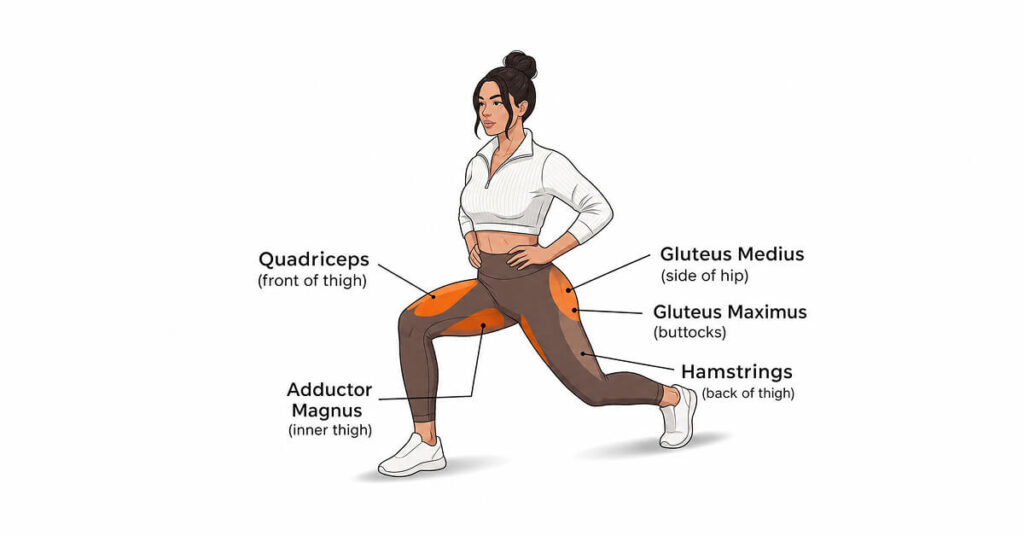
A split squat is mainly a lower-body extension exercise: the front hip and knee bend on the way down, then extend on the way up.
The main working muscles are the gluteus maximus, quadriceps, and adductor magnus, with the hamstrings assisting and the hip stabilizers working hard to keep the pelvis and femur controlled.
Gluteus maximus
The gluteus maximus helps extend the hip as you drive up from the bottom. It becomes especially important when the front hip is flexed deeply and when the stance or torso angle increases the demand at the hip.
In simple terms:
- more controlled hip flexion usually increases glute relevance
- a slightly longer stance can make the movement feel more hip-driven
- a slight forward torso lean often makes the front glute feel more involved
Quadriceps
The quadriceps extend the front knee as you stand up. They are usually very active in split squats because the front knee has to control the descent and help drive the body upward.
You will usually feel more quad demand when:
- the torso is more upright
- the front knee travels farther forward
- the stance is shorter or more knee-dominant
- the movement is performed through deep knee flexion
Adductor magnus
The adductor magnus is often ignored, but it matters in split squats. It helps with hip extension and helps control the thigh as the front leg works through the rep.
This is why split squats can feel like more than “glutes and quads.” A strong split squat often involves the inner-thigh/adductor region, especially when the stance is wider or the front hip is loaded deeply.
Hamstrings
The hamstrings assist with hip extension, but they are usually not the main driver in a standard split squat. Because the front knee bends during the movement, the hamstrings are not usually loaded in the same lengthened way as they are during Romanian deadlifts or stiff-leg hinges.
That does not mean they are inactive. It means the split squat is generally better viewed as a glute + quad + adductor movement than a pure hamstring builder.
The Front Leg Does Most of the Useful Work
The rear leg should help you balance, not take over the exercise.
In a well-executed split squat, the front leg controls most of the lowering and performs most of the drive up. The rear leg contributes support, but if it becomes the main pusher, the exercise loses much of its purpose.
Front leg contribution
The front leg is responsible for:
- controlling the descent
- absorbing the bottom position
- extending the hip and knee on the way up
- keeping the knee tracking cleanly
- maintaining foot pressure through the rep
Rear leg contribution
The rear leg helps with:
- balance
- light support
- position control
- preventing the movement from becoming unstable
It should not feel like the rear quad, rear hip flexor, or rear calf is doing most of the work.
What it means if the rear leg takes over
If you feel the rear leg doing too much, it usually means:
- the stance is too short
- the rear foot is uncomfortable
- the load is too heavy
- you are pushing backward instead of driving through the front foot
Save those fixes for the technique page. On this muscles-worked page, the important point is that rear-leg dominance changes the training stimulus.
Stance Length Changes Glute vs Quad Emphasis
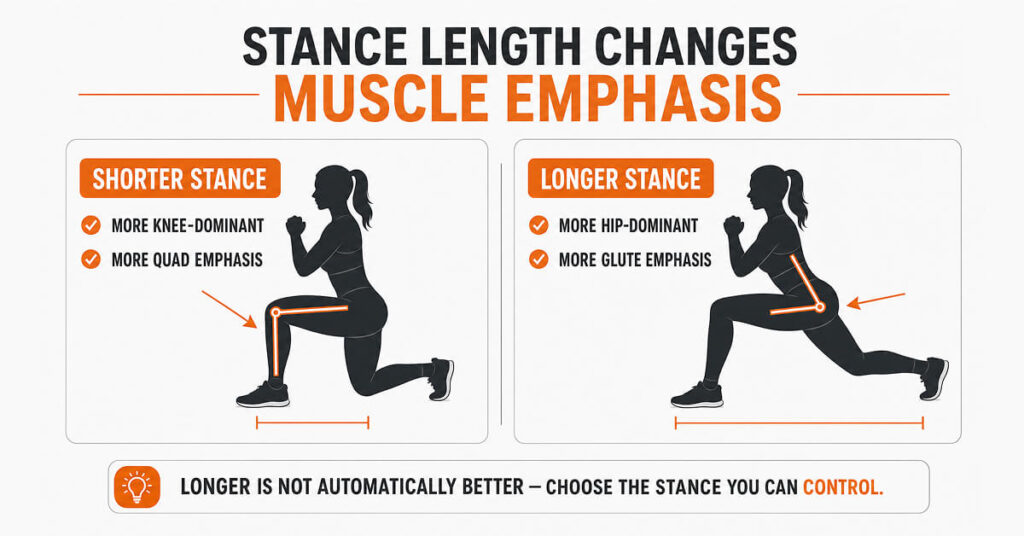
Stance length is one of the biggest “muscle bias” dials in split squats.
A 2023 study on split squat step length found that changing step length changed hip, knee, ankle mechanics and muscle activation. As step length increased, hip extensor demand and activation increased, while knee extensor demand was affected less. The authors concluded that longer step lengths had greater influence on hip extensor muscles than knee extensor muscles, and that a step length equal to the individual’s lower-extremity length appeared suitable for strength training in healthy adults.
Effects of step lengths on biomechanical characteristics during the split squat movement.
Shorter stance tendency
A shorter stance usually makes the split squat feel more knee-dominant.
Common effects:
- more forward knee travel
- more quad sensation
- less hip-dominant feel
- sometimes more rear-leg involvement if the stance gets too cramped
Longer stance tendency
A longer stance usually shifts more of the challenge toward the hip extensors.
Common effects:
- more glute involvement
- more hip-extension demand
- less knee-dominant feel
- greater need for stability and control
Longer is not automatically better
A stance that is too long can reduce control and make the rep unstable. The goal is not to create the longest possible stance. The goal is to choose a stance that loads the front leg well while still letting you control depth, pelvis position, and foot pressure.
Torso Angle Changes the Bias Too
Torso angle changes whether the split squat feels more like a hip-dominant movement or a knee-dominant movement.
A more upright torso usually keeps the movement more quad-forward. A slight forward torso lean usually increases the hip-extension demand and can make the glute contribution more obvious. This matches research discussion in the split squat/lunge family showing that trunk position can influence hip and knee extensor demands.
More upright torso
Usually biases:
- quadriceps
- front knee extension
- a more “vertical” split squat feel
This is not bad. It is useful when quad development is part of the goal.
Slight forward torso lean
Usually biases:
- gluteus maximus
- adductor magnus
- hip extension
This is useful when the goal is a more glute-focused split squat.
Excessive forward lean
Too much lean can turn the movement into a balance problem or a low-back compensation. The best torso angle is the one that shifts the work where you want it while still allowing consistent reps.
Stabilizers Are a Bigger Part of the Split Squat Than the Squat
Split squats do not just train the muscles that move you up and down. They also train the muscles that stop you from twisting, dropping, or collapsing.
Because the stance is asymmetrical, the body has to control more side-to-side and rotational forces than in a basic bilateral squat. This makes stabilizers more important.
Gluteus medius and minimus
The gluteus medius and minimus help control the pelvis and femur. They become especially important when the front knee wants to collapse inward or the pelvis wants to drop or rotate.
You may notice them more when:
- loading is heavy
- the stance is narrow
- you are close to fatigue
- you are doing rear-foot elevated variations
Foot and ankle stabilizers
The front foot has to stay connected to the floor. The calf and smaller foot/ankle muscles help stabilize the lower leg and keep the rep from drifting.
This is one reason split squats can feel “harder” than the load suggests.
Trunk stabilizers
Your trunk helps keep the pelvis and ribcage organized. If the torso rotates or side-bends heavily, the split squat becomes less effective for the front leg and more like a compensation pattern.
Split Squat vs Squat: What Actually Changes?
Split squats and squats overlap, but they are not interchangeable.
Both train hip and knee extension, but the split squat puts one leg in the lead role and increases the demand for unilateral control. A biomechanical comparison of the Bulgarian split squat and back squat found that both were hip-dominant exercises, but the Bulgarian split squat showed lower knee-joint demands than the back squat in that study and was discussed as useful when the goal is focusing on hip extension while reducing knee-joint demand.
Squat
The squat is better when you want:
- bilateral loading
- heavier total load
- more symmetrical lower-body force production
- a simpler progression benchmark
Split squat
The split squat is better when you want:
- front-leg focus
- side-to-side comparison
- more pelvic and hip stability demand
- a way to train hip/knee extension without relying only on bilateral squat patterns
This is why split squats deserve their own hub, not just a small “variation” section under squats.
Machine-Supported Split Squats Make the Target Muscles Easier to Load
The biggest limitation in split squats is often not strength. It is setup, balance, and rear-foot position.
A stable machine setup can reduce those distractions. With a dedicated rear-foot support, handles, and a consistent platform, the working leg is easier to load repeatedly. That is especially useful when the goal is glute and quad hypertrophy rather than balance practice.
What the machine helps standardize
Machine-supported split squats help make these variables more repeatable:
- rear-foot height
- stance length
- front-foot placement
- balance support
- loading progression
- range of motion
Why that matters for muscles worked
When balance becomes the limiter, the target muscles may not receive the best training stimulus. A more stable setup lets you push the front glute, quad, and adductor harder because fewer reps are lost to wobbling, repositioning, or rear-foot discomfort.
Booty Builder machine application
In the Booty Builder lineup, the Selectorized Deadlift/Split Squat machine is especially useful here because it gives the split squat a more controlled setup: rear-foot support, stable platform, handles, and selectorized loading. That makes it easier to bias the front leg and repeat the same muscle stimulus across sets.
Key Takeaways
- Split squats mainly train the front-leg glutes, quadriceps, adductors, and stabilizers.
- The rear leg should support the movement, not dominate it.
- Stance length is a major bias tool: shorter tends to feel more quad-forward, longer tends to increase hip-extensor demand.
- Torso angle also changes the stimulus: upright usually feels more quad-biased, slight forward lean usually feels more glute/hip-biased.
- Split squats differ from squats because they add unilateral control, pelvic stability, and front-leg loading.
- Machine-supported split squats make the muscle stimulus easier to standardize by reducing balance and setup limitations.