

Best Deadlift Variations
The Best Deadlift Variation Is the One That Matches Your Goal and Lets You Repeat Great Reps
“Best” doesn’t mean the hardest variation. It means the variation you can train consistently with clean mechanics, so the target muscles, not your setup or form breakdown, become the limiting factor.
Deadlift variations exist because different bodies, goals, and constraints need different hinge solutions. Some variations are better for heavy strength, some are better for controlled posterior-chain hypertrophy, and some are simply better for consistency and progression, especially when you can standardize setup on a deadlift machine. This guide breaks down the best deadlift variations and exactly when each one earns a spot in a glute-focused training plan.
What You’ll Learn in This Article
- The 3 “dials” that determine what a deadlift variation emphasizes
- The best deadlift variations for strength, hypertrophy, and glute focus
- Which variations tend to feel more glute-biased vs hamstring-biased
- When partial-range variations make sense (and when they don’t)
- Why machines can be an advantage for repeatable hinge training
- A simple way to rotate variations without losing progress
The 3 Dials That Change What a Deadlift Variation Trains
Most deadlift variations are the same pattern—hip hinge + braced torso—but they change what’s hardest by changing geometry and constraints.
Dial 1: Range of motion and start height
- Floor pulls and deeper starts expose the “from-the-bottom” portion of the hinge.
- Elevated starts (blocks/rack pulls) shorten the range and emphasize the top portion.
Dial 2: Knee bend vs hinge depth
- More knee bend generally increases knee extension contribution (often more “whole leg”).
- Less knee bend with a deeper hinge generally increases posterior-chain tension (often more “hamstrings/hips”).
Dial 3: Stability and repeatability
- More setup variability = more chances for reps to change shape under fatigue.
- More stable setups (often machines) make it easier to repeat the same start position and bar/handle path.
The Best Deadlift Variations for Most Lifters
If your goal is glute and posterior-chain development, you usually don’t need every variation; you need 1–2 that you can progress, and 1–2 that fill the gaps.
Conventional Deadlift (Straight Bar From the Floor)
Best for: full-body strength, hinge skill, “real” heavy pulling
Why it earns a spot: it trains hip extension and bracing under high total-body tension.
Watch-outs: technique drift under fatigue (hips shooting up, bar drifting forward) can turn it into a lower-back-limited rep.
Use it when:
- You want a primary strength lift
- You can keep reps consistent and the bar close
- You have the recovery budget for heavy hinge work
2) Romanian Deadlift (RDL)
Best for: posterior-chain hypertrophy, controlled tension, cleaner reps for many lifters.
Why it earns a spot: RDLs keep the hinge pattern front-and-center by limiting knee movement and emphasizing a controlled eccentric.
Watch-outs: turning it into a “reach-the-floor-at-all-costs” rep often leads to lumbar motion instead of hip hinge.
Use it when:
- You want more hamstring/hip tension with less “from-the-floor” complexity
- You want a hinge you can control at moderate-to-high reps
- You want a hypertrophy-friendly deadlift pattern
Trap Bar (Hex Bar) Deadlift
Best for: heavy loading with a different joint-moment profile, athletic intent (force/velocity), beginners learning a deadlift pattern
Why it earns a spot: the hex bar allows you to stand “inside” the load, which changes the resistance moments compared to a straight bar. In a classic biomechanics study, the hex bar deadlift allowed a heavier 1RM and shifted joint moments (lower peak moments at the lumbar spine and hip, higher at the knee) compared with straight-bar pulling.
A biomechanical analysis of straight and hexagonal barbell deadlifts (PubMed)
Use it when:
- You want a deadlift that many lifters find easier to standardize
- You want a strong “push the floor” deadlift feel
- You want a heavy hinge option that may feel less back-limited for some people
4) Sumo Deadlift
Best for: lifters who pull better with a wider stance, those who want a different hip/adductor/quads blend, reducing bar travel for some builds
Why it earns a spot: sumo changes stance width, torso position, and knee/hip angles compared to conventional. In published biomechanical and EMG work, sumo is commonly characterized by a wider stance and more toe-out, and it can shift muscle activity patterns (often higher quadriceps activity compared with conventional in certain analyses).
Watch-outs: sumo is not “automatically safer” or “automatically better”—it’s a different tool that fits some structures better than others.
Use it when:
- Conventional feels inefficient or you struggle to stay close to the bar
- You want a stance that can involve more knees/adductors relative to a pure hinge feel
- You compete in powerlifting and are experimenting with style
5) Deadlift Machine
Best for: repeatable hinge training, posterior-chain hypertrophy, fast setup, consistent start positions
Why it earns a spot: machines can reduce setup variability, so you spend more effort on producing output and less effort “building the lift” every set. This is especially useful for hypertrophy blocks where you want high-quality volume and consistent reps.
Use it when:
- You want to standardize start depth and handle position
- Grip, setup time, or bar path inconsistency is limiting your hinge work
- You want to push sets hard with less technique drift
Where Booty Builder-style machines fit (positive, factual)
Booty Builder’s selectorized deadlift-focused machines are designed to support multiple hinge variations with adjustable settings (e.g., handle height options and a stable platform), making it easier to repeat the same setup and accumulate high-quality posterior-chain volume.
6) Single-Leg RDL (Unilateral Hinge)
Best for: hip stability, glute medius/minimus support work, addressing side-to-side control
Why it earns a spot: unilateral hinges force the pelvis and hip stabilizers to work harder to keep alignment—useful when “one side takes over” in bilateral pulls.
Watch-outs: balance can limit loading, so don’t treat this as your only heavy hinge.
Use it when:
- You want a stability-focused hinge accessory
- You notice asymmetry or shifting in bilateral pulls
- You want a glute-focused accessory that doesn’t require huge loads to be effective
“Situational” Variations That Are Useful in the Right Context
These variations aren’t mandatory, but they solve specific problems in strength progression or technique.
Block Pulls / Rack Pulls (Partial Deadlifts)
Best for: overload in a shorter range, practicing top-end positions, managing fatigue
Good use case: when full-range pulls are too fatiguing to do often, but you still want heavy hinge exposure.
Watch-out: partial range is not a replacement for full-range posterior-chain training if your goal is hypertrophy across long muscle lengths.
Deficit Deadlifts (Increased Range)
Best for: practicing the start, improving strength off the floor (for some lifters), building control in deeper positions
Watch-out: only use a deficit you can control without losing brace or turning it into spinal motion.
Stiff-Leg Deadlifts
Best for: advanced posterior-chain tension work when you can maintain position
Watch-out: this variation raises the demand for hinge control—if your back position changes, it stops being a hamstring-focused tool and becomes a compensation pattern.
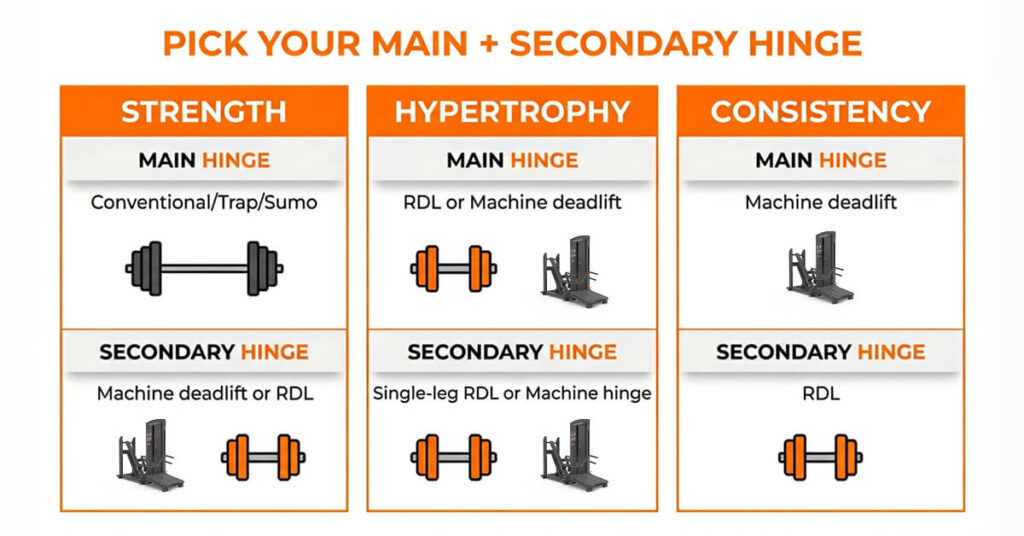
A Simple Way to Choose Your “Best” Variation
Instead of chasing novelty, pick one main hinge and one secondary hinge that complements it.
If your goal is maximal strength
Pick 1 main:
- Conventional deadlift or trap bar deadlift or sumo deadlift
Add 1 secondary (lower fatigue / technique builder): - Machine deadlift or RDL
If your goal is glute and hamstring hypertrophy
Pick 1 main:
- RDL or machine deadlift
Add 1 secondary: - Single-leg RDL or a second machine/hinge angle (to keep volume high and reps clean)
If your goal is consistency and repeatability
Pick 1 main:
- Deadlift machine (selectorized or plate-loaded)
Add 1 secondary: - RDL pattern (barbell or machine), then rotate in conventional/trap bar if desired
Key Takeaways
- Deadlift variations mainly differ by range of motion, knee/hip angles, and setup stability.
- Conventional, RDL, trap bar, sumo, machine deadlifts, and single-leg RDL cover the majority of needs for strength + glute-focused training.
- Machines are a powerful option when you want repeatable setups, high-quality volume, and less “setup fatigue.”
- Your best variation is the one you can progress while keeping reps consistent and controlled.