

Barbell vs Machine Hip Thrust
The “Best” Hip Thrust Is the One You Can Progress With Consistent High-Quality Reps
Most debates about barbell vs machine hip thrusts focus on one thing: the number on the load. But for glute growth and strength, the more important question is: which setup lets you repeat great reps, week after week, without technique, comfort, or setup becoming the limiting factor?
A barbell hip thrust and a hip thrust machine can both overload hip extension. The real differences show up in how resistance is applied, how repeatable your setup is, and how easy it is to train hard without distractions.
What You’ll Learn in This Article
- What actually changes mechanically between barbell and machine hip thrusts
- Why the same “weight” can feel very different across setups
- The most important advantages of machines (without hype)
- How to choose based on your goal: hypertrophy, strength, comfort, time, or consistency
- How to switch between barbell and machine without losing performance
The Mechanical Difference Is Not the Movement—It’s How Resistance Is Delivered
| Feature | Barbell | Machine |
|---|---|---|
| Setup | Instant & integrated | |
| Stability | Fixed-path isolation | |
| Comfort | Padded belt system | |
| Resistance | Variable strength curve |
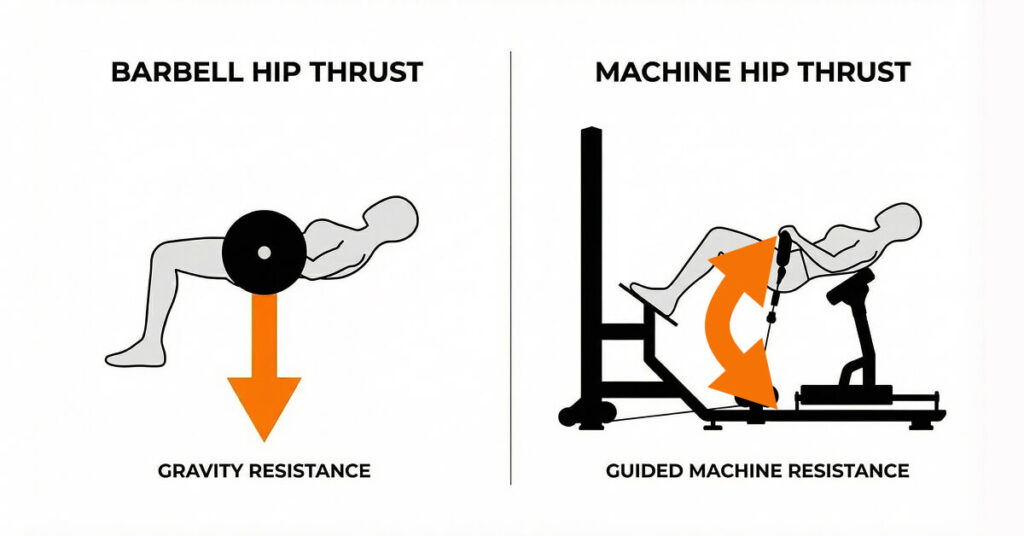
Barbell hip thrust = gravity-based resistance + a “free” setup you must control
With a barbell, resistance comes from gravity pulling straight down on the bar. Your job is to keep the setup stable (bench position, shoulder contact point, bar placement, foot traction) while you drive hip extension.
A key takeaway from published biomechanics on the barbell hip thrust is that hip extensor demand is high, but it’s not identical at every point in the rep. If you want the detailed breakdown of joint moments and how they change through the lift.
Practical implication: on a barbell hip thrust, the “hardest” portion of the rep is not guaranteed to be the same for everyone, because small setup differences (bench height, ribcage position, foot distance, bar path) can change leverage.
Hip thrust machine = guided resistance + higher repeatability from rep to rep
A hip thrust machine still trains the same action, hip extension, but it typically improves repeatability by controlling key variables:
- A more consistent back support position (instead of whatever bench height you find)
- A fixed foot platform (traction + repeatable stance)
- A belt/pad interface that avoids the common barbell issues (rolling bar, pad shifting)
The important point for credibility: machines are not “magic.”
They’re valuable because they reduce the number of moving parts that can steal output from the rep.
Why Machine “Weight” Often Feels Different Than Barbell Weight
The number is not the stimulus; joint torque is
Comparing “100 kg on a barbell” to “100 kg on a machine” is usually a mistake because machines can change:
- Lever arms through the range of motion
- The direction the resistance is applied
- How much stabilization you need to spend just to hold position
That’s why two setups can feel dramatically different even when the load numbers look similar.
Practical rule:
If you’re switching implement (barbell → machine or machine → barbell), track progress using:
- reps in reserve (RIR)
- clean rep quality
- range of motion consistency
- load within that setup
Not by trying to “match” numbers across tools.
What “better resistance” should mean in practice
A “better” resistance profile is not one specific curve—it’s the one that matches your goal and lets you train hard without form drift.
- If a setup makes you lose pelvic control, cut depth, or overextend your lower back to finish reps, it’s not “better,” even if it feels brutal.
- If a setup lets you own the bottom, control the rep, and keep the glutes as the limiting factor, it’s usually a better long-term builder.
Where Machines Often Win in the Real World (Comfort + Repeatability)
Less friction between your intent and the rep
For hypertrophy, quality volume matters. Machines can make it easier to repeat high-quality volume because they often reduce:
- setup time
- pad/bar positioning problems
- bench instability
- energy leakage from shifting and bracing for equipment instead of the movement
This is not about “easy.” It’s about making effort and technique the limiter, not logistics.
Pelvic contact is a real limiting factor on barbell hip thrusts
On barbells, discomfort at the pelvis can cap loading or reduce your ability to push sets close to failure.
A belt/pad system commonly improves tolerance, which can make hard training more realistic, especially at higher volumes.
Range of motion is easier to standardize on many machines
With barbells, your effective range can change if the bench height changes, you slide, or you shift your foot placement to avoid discomfort.
Many hip thrust machines are designed to make positioning more repeatable (footplate + back support + belt/pad). The performance advantage is not theoretical: it’s the fact you can more easily do the same rep every session.
Can You Train Heavy on a Machine?” Yes—But Know What Limits Each Option
Barbell heavy is real, but often limited by setup, comfort, and time
Barbells can be loaded very heavy, but the practical bottlenecks are common:
- time to set up
- finding the right bench and surface
- bar comfort/rolling
- needing pads, spotters, or awkward unracking strategies
Machines can be trained very heavy; model design determines the ceiling
There are two common categories:
- Selectorized (weight stack): fast to adjust, great for busy gyms and repeatable loading
- Plate-loaded: often preferred when you want maximal loading flexibility and simple progression
Booty Builder-specific:
- The Booty Builder Platinum V4 is plate-loaded, and the product specs list a max total load of 200 kg / 441 lbs.
- The Booty Builder V8 product has a 350 lb / 160 kg selectorized weight stack.
This matters because it shows a machine hip thrust is not inherently “light”—it can be built for serious progression.
How to progress when the machine and barbell don’t match
- Use a progression method that works across both tools:
- Keep the same target rep range (example: 6–10 or 8–12)
- Add load only when you can hit the top of the range with the same RIR and ROM
- If load jumps are large on a stack, progress by:
- adding reps first
- adding a set (when appropriate)
- slowing the eccentric slightly
- using bands (if the machine supports them)
Technique Differences That Matter When You Switch Between Barbell and Machine
Your “pivot point” must stay consistent
- Barbell: your shoulder position on the bench can drift without you noticing
- Machine: backrest position is fixed/adjustable, set it once and repeat it
If your pivot point moves, the lift can feel different even if you don’t change load.
Foot placement is still the #1 performance lever
Across both barbell and machine:
- choose a stance that lets you reach full hip extension without lumbar overextension
- keep feet planted and control the eccentric
- aim for consistent depth you can own
Lockout should look the same on both
Lock out by finishing hip extension while keeping the ribcage stacked over the pelvis. If you “finish” by flaring ribs and arching hard through the lower back, you’re shifting the stress away from the glutes.
Which Should You Choose?
Choose the machine if you want the most repeatable glute-focused output
A hip thrust machine is usually the better choice when:
- you want faster setup and more consistency session-to-session
- barbell discomfort limits your loading or effort
- you want to take sets closer to failure with less setup risk
- you want a stable base for high-quality hypertrophy volume
- you want unilateral work with stability (B-stance and single-leg are absolutely doable on many machines)
Choose the barbell if you need maximum accessibility and minimal equipment dependence
A barbell hip thrust is a strong choice when:
- you don’t have access to a good hip thrust machine
- you want a “low-tech” option that works in any gym
- you enjoy the skill component and can standardize your setup reliably
Best Practice for Most Lifters: Use Both (Even If One Is Your Main Builder)
If you have access to a high-quality hip thrust machine, a practical approach is:
- Make the machine your primary progressive overload tool (repeatability + comfort)
- Use barbell hip thrusts as a secondary option when:
- the machine is taken
- you want a different setup feel
- you’re training somewhere without the machine
This keeps training consistent without turning equipment choice into an identity.