

Best Hip Thrust Variations
Pick the Variation That Lets You Train Heavy and Clean (Not the One That Sounds Cool)
The “best” hip thrust variation is the one that lets you apply the most effective effort to the glutes, heavy enough, stable enough, and repeatable enough that progress is obvious over time.
This page is not here to debate “barbell vs machine” (we have a dedicated comparison page for that). The goal here is simpler: help you pick the right hip thrust variation based on what’s limiting your performance, setup friction, stability, lockout difficulty, unilateral needs, or home equipment.
A key point up front: you absolutely can train very heavy on a hip thrust machine. In fact, for many lifters, the machine is the easiest way to load hard without setup and discomfort becoming the limiter. Also, machine load is not directly comparable to a barbell; different lever arms/resistance profiles mean the “same number of plates” can feel very different. Use reps-in-reserve (RIR) / effort as your comparison, not the load number.
What You’ll Learn in This Article
- How to choose a hip thrust variation based on your limiting factor (comfort, stability, lockout, unilateral, home training)
- Why machines are not “light” and why load comparisons across equipment are misleading
- The best machine-friendly variations (including B-stance and single-leg on the machine)
- When banded hip thrusts are worth it (and why they change the feel)
- The few “advanced tweaks” that add challenge without changing the exercise
Hip Thrust Variation Selector
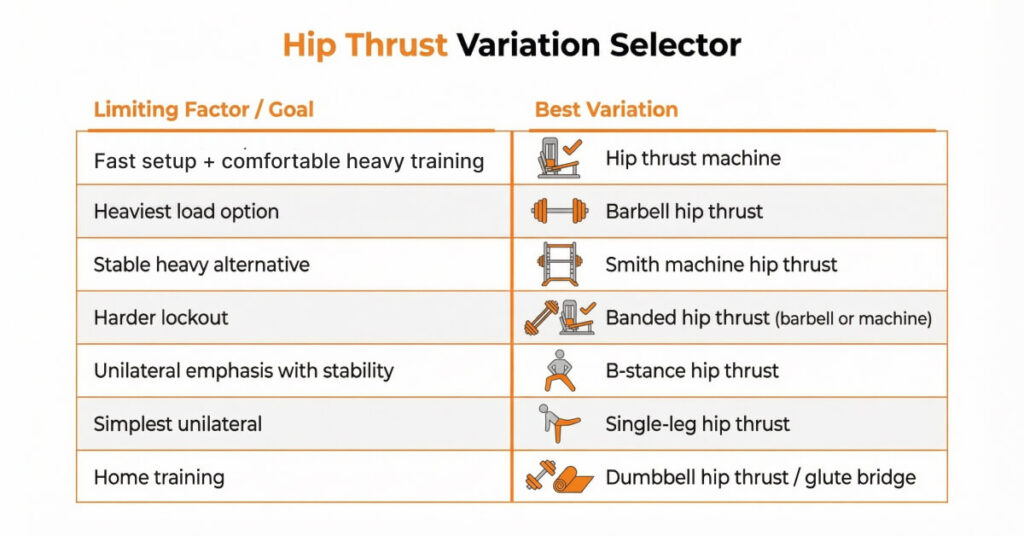
Choose your variation based on what’s limiting you
- Fast setup + comfortable heavy training → Hip thrust machine
- Maximum load flexibility (any plates, any time) → Barbell hip thrust
- Guided heavy option (when no hip thrust machine) → Smith machine hip thrust
- Harder lockout / top-end overload → Banded hip thrust (barbell or machine)
- Unilateral emphasis with stability → B-stance hip thrust (machine or barbell)
- Simplest unilateral → Single-leg hip thrust (machine, bodyweight, or light load)
- Home training → Dumbbell hip thrust / glute bridge
Variation 1 — Hip Thrust Machine
If glute growth is the goal and a good machine is available, this is often the best default variation because it makes heavy, high-effort sets easier to repeat with less setup noise.
Why the machine is a true “heavy training” option
- Stability is built in, so your effort can go into hip extension instead of fighting the setup.
- Comfort is usually better, which matters when you’re pushing close to failure (discomfort changes mechanics fast).
- Setup is repeatable, so progression is clearer week to week.
- Load often feels different (sometimes much harder per plate) due to machine geometry, so judge by effort, not the number.
Machine hip thrust (bilateral) — your main builder
Use this as your primary progressive overload variation for most glute wokrouts.
B-stance hip thrust on the machine
This is one of the best ways to add unilateral emphasis without making balance the limiting factor.
- Front/working leg does most of the work
- Back leg is a “kickstand,” not a second driver
- Easier to keep pelvis square than strict single-leg for many lifters
Single-leg hip thrust on the machine (high stimulus, low chaos)
If the platform allows safe foot placement and you can keep the pelvis level, machine single-leg is a very efficient unilateral option.
- Great when you want unilateral glute work without needing high external loading
- Heavy muscle work without the high load on joints
Machine hip thrust + bands (if the machine supports it)
If your machine has band pegs / band options, bands are a clean way to make lockout more demanding without changing the pattern.
Variation 2 — Smith Machine Hip Thrust
This is the best “guided heavy” solution when you don’t have a dedicated hip thrust machine but want more stability than a free barbell.
Best use cases
- You want heavy loading with a more stable path
- You want easier re-racking near failure
- Your gym setup makes barbell thrusts awkward (benches moving, limited space)
What to watch
Because the bar path is fixed, you may need to adjust foot placement so lockout stays hip extension (not low back compensation).
Variation 3 — Barbell Hip Thrust
The classic free-weight hip thrust is still a top-tier variation—especially for load flexibility and accessibility.
Why it’s still worth using
- Works in almost any gym with a bar + bench
- Extremely simple to load and progress
- Useful when the machine is taken or not available
Main drawback (selection logic, not a complaint)
The barbell version often adds friction: bench setup, pad comfort, bar positioning, and time. If those things reduce your effort output, the machine will usually be the better choice for that training phase.
Variation 4 — Banded Hip Thrust
Banded hip thrusts are the best “variation” when your problem is simple: you coast through lockout and want the top half to demand real effort.
Why bands change the challenge
A biomechanical analysis of the barbell hip thrust reported that hip extension moment decreases as the hip extends through the lift, rather than staying consistent. That’s one reason many lifters use bands (or certain machine designs) to make the top-end feel more demanding.
Best use cases
- You want a harder lockout without changing the main exercise
- You’re already doing a consistent barbell or machine hip thrust and need a small progression tool
Variation 5 — Unilateral Options (Do These on the Machine or With Free Weights)
Unilateral hip thrust work isn’t a separate category anymore; you can do it wherever you can keep alignment clean.
Best unilateral choice for most lifters
- B-stance for stability + loadability
- Single-leg for pure unilateral stimulus (often lighter loads)
Practical rule: pick the version where you can keep the pelvis square and avoid twisting. If your form degrades, the “variation” is just a new way to cheat.
Variation 6 — Home-Friendly Variations
Dumbbell hip thrust
Best home option when you can bench against a couch/bench and want a simple setup.
Glute bridge
Useful when you need minimal setup. Typically shorter ROM than a bench hip thrust, but still valuable for high-rep work, warm-ups, or extra weekly volume.
Advanced Tweaks That Count as “Variations” Without Changing Equipment
Use these when you want more challenge while keeping your main lift consistent:
Paused reps
Add a 1–2 second pause at lockout to eliminate bouncing and force control.
1.5 reps
Up → half down → up → full down = 1 rep. Great for extending time under tension.
Tempo-controlled eccentrics
Only if you can keep positioning consistent.
Quick Recommendations
- Best default for heavy, repeatable glute training: Hip thrust machine
- Best guided option without a hip thrust machine: Smith machine hip thrust
- Best “any gym, any plates” option: Barbell hip thrust
- Best lockout overload add-on: Banded hip thrust (barbell or machine)
- Best unilateral on a stable setup: B-stance on the machine
- Best simple unilateral accessory: Single-leg on the machine (or bodyweight/light load)