

Hip Thrust Muscles Worked and Biomechanics
Why Understanding “What’s Working” Changes Your Results
Many people add hip thrusts for glute growth—but end up feeling mostly hamstrings, quads, or low back. The problem is rarely effort. It’s usually that the mechanics of the rep (joint angles, leverage, and stability demands) are shifting the workload away from the muscles you’re trying to train.
This page breaks down the hip thrust from a biomechanics perspective so you can understand:
- Which muscles are actually producing hip extension
- Which muscles are stabilizing
- Where in the range of motion the joint demand is highest (and why that matters)
- How machines can make high-quality glute loading easier to repeat
What This Guide Explains
- The primary hip extensors involved in a hip thrust (and what each one contributes)
- Which muscles act mostly as stabilizers (and why you still feel them)
- Why a hip thrust is considered hip-dominant compared with many other lower-body lifts
- What research shows about joint moments during the barbell hip thrust (and why “constant tension” is often misunderstood)
- How the resistance profile changes when you use a dedicated hip thrust machine
The Hip Thrust Is a Hip-Dominant Extension Pattern
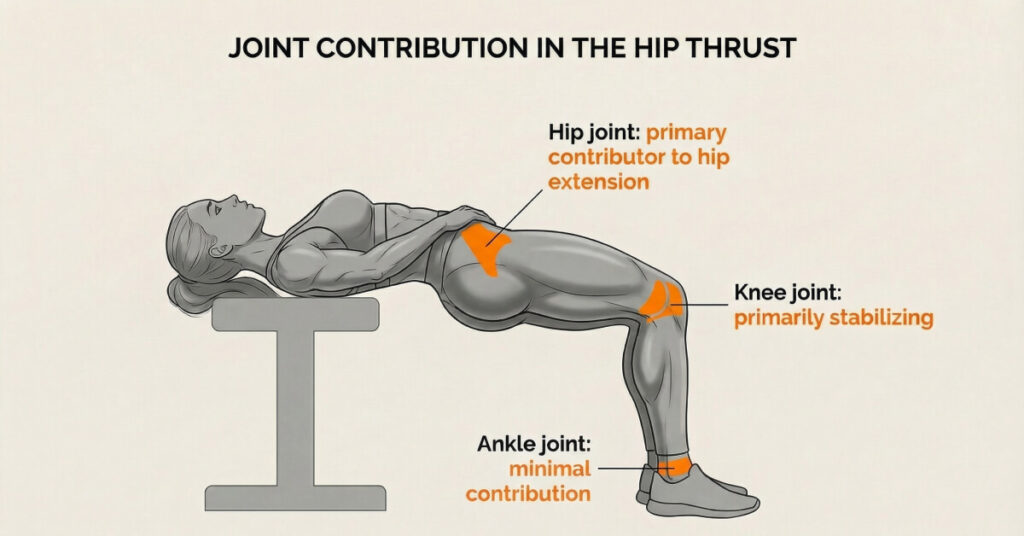
A hip thrust is essentially a loaded bridge where your torso is supported (bench or machine pad), and the main job is to extend the hips from a flexed position to full extension.
Biomechanically, the biggest “takeaway” is this:
The hip joint does most of the work, the knee helps, the ankle contributes little
In a detailed biomechanical analysis of the barbell hip thrust, the hip thrust produced a larger extensor demand at the hip than at the knee and pelvic-trunk joints, while ankle joint kinetics were small (i.e., the ankle isn’t a major driver of the movement).
Practical meaning: hip thrusts are a reliable way to train the hip extensors without turning the lift into a calf/ankle-dominant task.
- “Hip extends (main motion)”
- “Knee stays relatively flexed (mostly stabilizing)”
- “Ankle motion minimal”
Primary Muscles Worked in the Hip Thrust
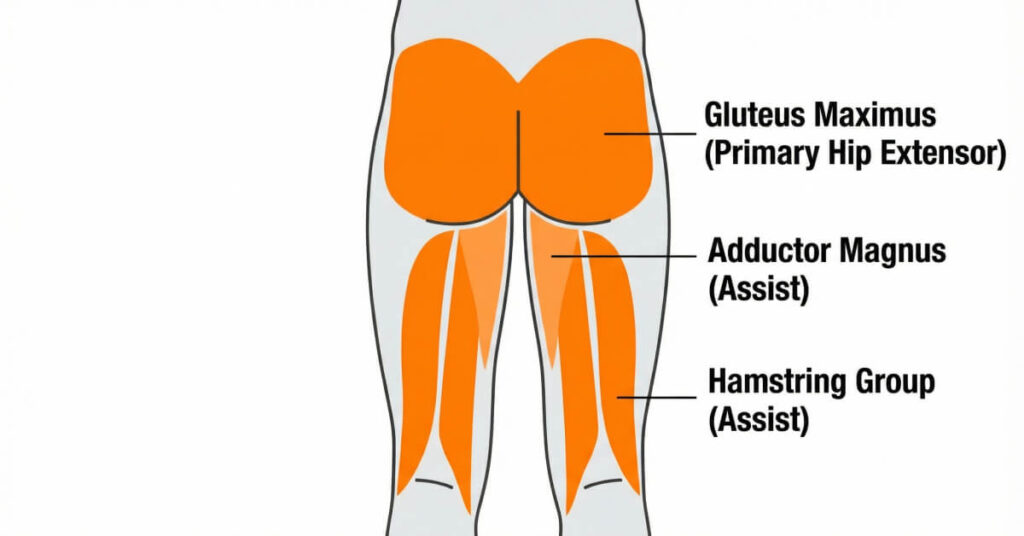
Think of the hip thrust as a “team lift.” One muscle is usually the star, but several others assist depending on your joint angles and stance.
Gluteus maximus (primary hip extensor)
The gluteus maximus is widely described as the primary hip extensor, responsible for initiating and producing hip extension, especially in tasks like rising from a seated position or climbing.
In hip thrusts, it’s the main engine driving the hips up and through to lockout.
What you’ll often feel when it’s doing its job:
- Strong contraction at lockout
- Fatigue in the glute region rather than the lower back
- A powerful “hip drive” without needing to over-arch
Hamstrings (assist hip extension, but their leverage depends on knee position)
The hamstrings assist with hip extension, but they also cross the knee. That matters because a two-joint muscle’s force contribution can change depending on the positions of both joints.
In a typical hip thrust setup, the knee stays relatively flexed, which can reduce how strongly the hamstrings contribute compared with positions where they’re more lengthened. That’s one reason many lifters experience hip thrusts as more “glute-dominant” than hinge patterns that start with more extended knees.
Important nuance (credibility point):
- Hamstrings still assist hip extension.
- But their contribution isn’t fixed; it changes with hip and knee angles.
Adductor magnus (a major, often-overlooked hip extensor helper)
Most people think “adductors = inner thigh.” But the adductor magnus is special: it has different portions with different roles. Anatomical references describe a “hamstring portion” that can extend the thigh (hip extension).
That means during hip thrusts, especially when you’re working from a hip-flexed position, the adductor magnus can contribute meaningfully to hip extension torque.
Practical meaning:
If you feel hip thrusts in your inner thigh and your glutes, that can be completely normal, particularly with wider stances or heavy loading.
Stabilizers and Support Muscles You Should Expect to Feel
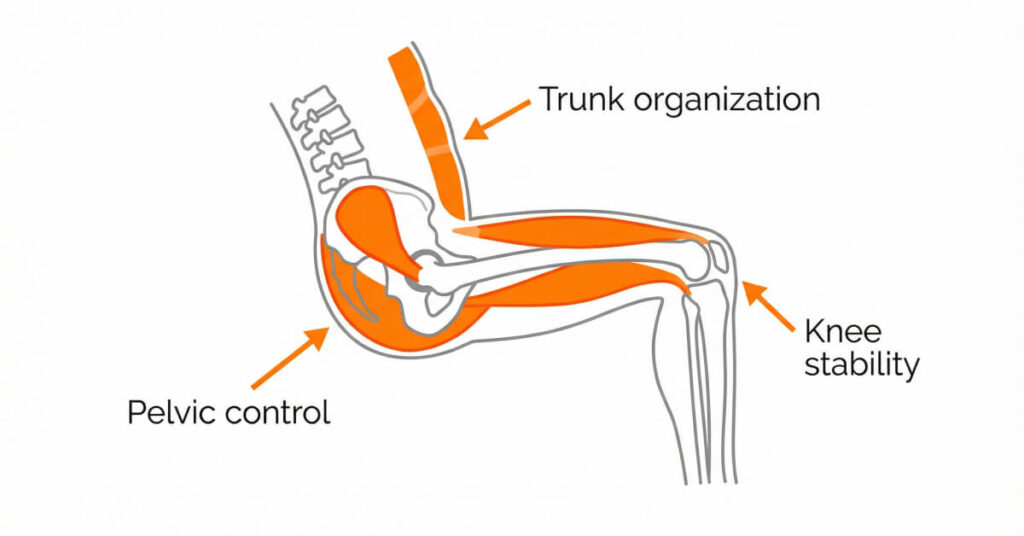
A hip thrust isn’t just “hip extension.” You’re also resisting unwanted movement (pelvis tilt, knee collapse, trunk flexion). That’s where stabilizers come in.
Gluteus medius/minimus (pelvic and femur control)
The gluteus medius and minimus are key hip abductors that help control pelvic position and femur motion. During hip thrusts, they help you maintain stable knee tracking and resist collapsing inward (especially under heavy loads or when fatigue hits).
You’ll notice them more when:
- Your stance is wider
- You struggle to keep knees from caving in
- You’re pushing near failure and stability becomes the limiter
Quadriceps (mostly stabilizing the knee)
Hip thrusts don’t involve large knee range of motion like squats. But you still need knee stability under load. Research on barbell hip thrust mechanics reports meaningful knee extensor demand despite a relatively small knee ROM, likely reflecting the job of stabilizing the knee position rather than driving the movement through a big arc.
Practical meaning:
Feeling quads during hip thrusts isn’t “wrong.” It often reflects your knees holding position while the hip extensors drive the rep.
Trunk musculature (keeping the pelvis and spine organized)
The hip thrust creates extensor demands not only at the hip, but also at the pelvic-trunk region, largely resisting trunk/pelvis flexion under load.
What this means in plain language:
Your core and trunk are there to keep the rep “clean,” so your hips can actually extend without the spine becoming the mover.
Biomechanics Through the Rep: Where the Hip Thrust Is Most Demanding
One of the biggest misconceptions about hip thrusts is that the external demand is “maxed out at lockout” in all setups.
Barbell hip thrust demand is not constant across the range of motion
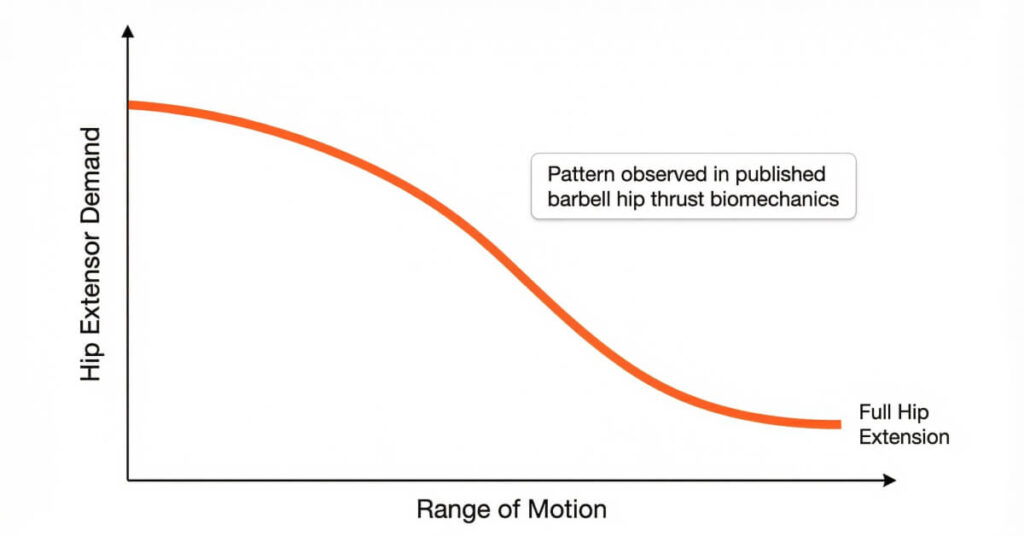
A comprehensive biomechanical analysis of the barbell hip thrust found that the hip extensor moment decreases as the hip extends, reaching a lower point near full extension. In that dataset, the peak hip extensor moment occurred early in the lifting phase, not at lockout.
Why this matters for training:
- The bottom-to-mid range can be the “heavier” portion mechanically in the barbell version
- Lockout can still feel intense because you can strongly contract the glutes there, but “feels hardest” and “highest external torque demand” are not always the same thing
Why the lockout still matters for glute training
Even if external hip moment decreases near full extension in the barbell hip thrust, the hip thrust still maintains an extensor demand close to full extension, something that may differ from some standing lifts where hip extensor moments can drop off near lockout.
Practical meaning:
Hip thrusts are still useful for loading hip extension in positions closer to full extension, just don’t assume the barbell version automatically gives “max torque at the top.”
Where to use an image (high value):
Add one simple custom graphic here (not a copied research figure):
- A “concept curve” showing hip extensor demand higher early → lower near lockout for barbell hip thrust
- A note: “Pattern shown in published barbell hip thrust biomechanics”
How Setup Variables Shift Muscle Emphasis (Without Changing the Exercise)
This isn’t a technique checklist (that’s on the form page). This is the biomechanics logic for why small changes alter what you feel.
Foot distance changes hamstrings vs quads contribution
- Feet farther away tends to reduce knee flexion and increase hamstring length → many lifters feel more hamstrings
- Feet closer tends to increase knee flexion → quads often feel more involved stabilizing the knee, and hamstrings may feel less dominant
Key point: these are tendencies, not rules. Your body structure and hip depth also matter.
Stance width can increase adductor involvement
A slightly wider stance often increases the need for the adductors (including adductor magnus) and abductors (glute med/min) to stabilize the hips and thighs, so “inner thigh + glute” is a common pairing in harder sets.
Barbell vs Hip Thrust Machine Biomechanics
The movement goal stays the same: hip extension under load. What changes is how consistently you can reproduce the rep, and how the resistance is applied across the ROM.
Machines reduce setup friction and increase repeatability
A dedicated hip thrust machine typically:
- Keeps your body position more consistent set to set
- Reduces time spent setting a bench, pads, and bar path
- Makes it easier to standardize foot placement and range
This doesn’t make machines “magic.” It makes them repeatable, and repeatability is a big deal when your goal is progressive overload and high-quality glute-focused volume.
Resistance profiles can be designed to match the hip thrust better
Unlike a free barbell (gravity always pulling straight down), machines can use levers/cams to change how resistance feels across the range.
Practical implication:
Some machine designs can keep the hip extensors more challenged deeper into lockout, useful if you specifically like loading the “finish” of hip extension.
Where Booty Builder-style machines fit in (positive, not hype)
Purpose-built machines (like Booty Builder hip thrust machines) are designed specifically around the hip thrust pattern. For many lifters, that design focus can improve:
- Comfort at the hips
- Stability
- Setup consistency
—all of which can help you train hard without technique breaking down first.
Key Takeaways
- The hip thrust is a hip-dominant extension exercise: glute max is the primary driver, with help from hamstrings and adductor magnus.
- Glute med/min, quads, and trunk musculature contribute mainly through stability and position control.
- In barbell hip thrust biomechanics, hip extensor demand is not constant; it tends to be higher earlier in the lift and lower near full extension.
- Machines can be a strong option because they improve repeatability and can offer different resistance profiles, depending on design.